
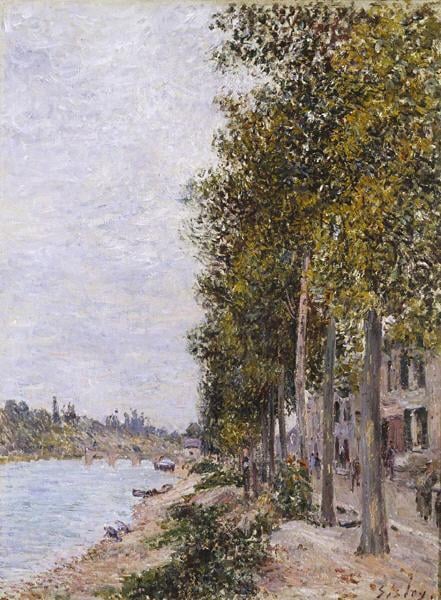
Expertenanalyse zu Alfred Sisleys Road Along the Seine at Saint Mammes
Stil: Impressionism · Genre: landscape
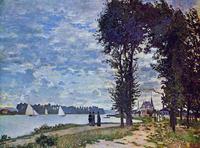
Expert Analysis: Road Along the Seine at Saint Mammes by Alfred Sisley
Alfred Sisley’s Road Along the Seine at Saint Mammes stands as a quintessential example of Impressionist landscape painting, embodying the movement’s core mission to capture fleeting moments of natural light and atmospheric conditions. Although the specific factual details provided are minimal—attributing the work to Sisley, the Impressionist style, and the landscape genre—the painting’s significance can be drawn from Sisley’s distinctive approach within the broader Impressionist canon.
Composition and Treatment of Light
As a dedicated plein-air painter, Sisley here likely dissolves the boundaries between road, river, and sky through broken brushstrokes and a luminous, high-key palette. The Seine at Saint-Mammès was a repeated subject for Sisley, who favored its tranquil, horizontal expanses. The road itself serves as a gentle diagonal leading the eye into the distance, while the water reflects the sky’s mutable tones—a hallmark of Impressionism’s fascination with the interplay of light and surface. Unlike Monet’s more dramatic experiments or Renoir’s figural focus, Sisley’s landscapes are notably serene and structurally balanced, giving his works an almost classical composure within the spontaneous Impressionist idiom.
Atmospheric Fidelity and Transience
The significance of this work lies in Sisley’s ability to render a specific, ephemeral moment—the angle of sunlight, the texture of clouds, the shimmer of the Seine—yet create a sense of enduring harmony. His brushwork is delicate, short, and rhythmic, avoiding the heavy impasto of some peers in favor of a softer, more lyrical touch. This painting likely exemplifies his mastery of atmospheric perspective, where the road and river gradually merge into a hazy, bluish distance, capturing the moist air typical of the Île-de-France region.
Sisley’s Place in Impressionism
Of all the Impressionists, Sisley remains the most consistently devoted to pure landscape. Road Along the Seine at Saint Mammes underscores his commitment to the genre without the narrative or social interests of Degas or Manet. Its significance lies in its quiet devotion to optical truth—the belief that a single, transitory view of a river road, painted in the open air, could be as profound as any historical or mythological scene. For this reason, Sisley’s landscapes are often considered the most pure distillations of Impressionist theory: faithful to nature, yet transformed by the artist’s personal response to color and light.
Conclusion
In Road Along the Seine at Saint Mammes, Sisley achieves what Impressionism set out to do—record the visual sensation of a moment. The work is significant not for narrative drama or technical novelty, but for its serene mastery of atmospheric nuance and its uncompromising focus on the beauty of the ordinary landscape. It stands as a testament to Sisley’s subtle, poetic vision within the movement.
Museum / Gallery
Visuell ähnlich
20 Werke mit ähnlicher Komposition und Farbpalette
Sunrise at Saint Mammes
Alfred Sisley
On the Banks of the Loing Canal
Alfred Sisley
The banks of the Loing Moret
Alfred Sisley
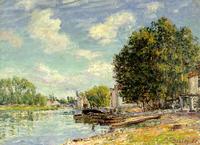
Moret Sur Loing
Alfred Sisley
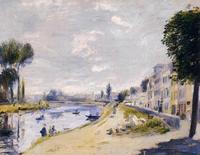
The Banks of the Seine
Pierre-Auguste Renoir
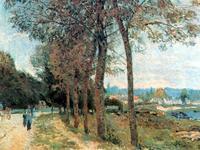
The Seine at Marly
Alfred Sisley
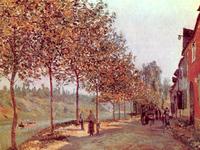
Morning in June (Saint Mammes et les Coteaux de la Celle)
Alfred Sisley
The Tugboat
Alfred Sisley
Banks of the Orne at Benouville
Francis Picabia
Moret Sur Loing
Alfred Sisley
At Moret sur Loing
Alfred Sisley
Quay at Dieppe
Gustave Loiseau
By the Oise at Parmain
Gustave Loiseau
Street Entering the Village
Alfred Sisley
Matratat s Boatyard, Moret sur Loing
Alfred Sisley
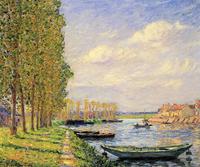
A Canal at St. Mammes
Francis Picabia
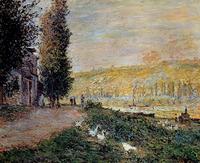
The Banks of the Seine, Lavacourt
Claude Monet
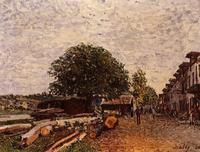
Construction Site at Saint Mammes
Alfred Sisley
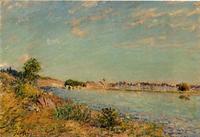
Saint Mammes
Alfred Sisley
The Banks of the Seine at Argenteuil
Claude Monet