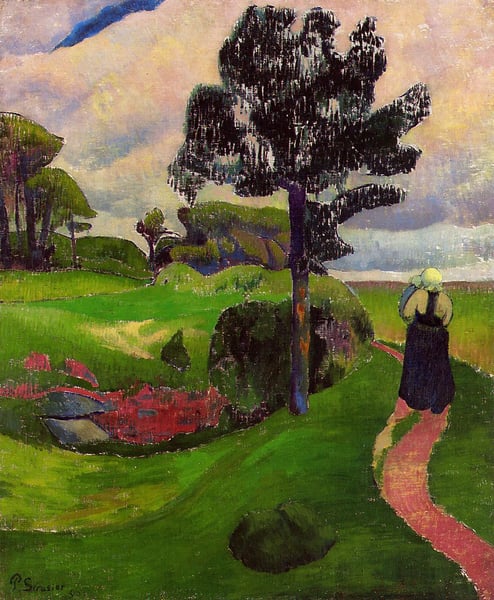
Mother and Child on a Breton Landscape
Dettagli
Analisi esperta di Mother and Child on a Breton Landscape di Paul Serusier
Stile: Synthetism · Genere: genre painting
This analysis focuses on Paul Sérusier’s “Mother and Child on a Breton Landscape” within the context of Synthetism and its genre painting status.
Expert Art Historical Analysis
As a foundational work of Synthetism, Paul Sérusier’s Mother and Child on a Breton Landscape is significant for its radical rejection of naturalistic representation in favor of a distilled, symbolic visual language. The painting exemplifies the core Synthetist principle: to “synthesize” a subject’s outward appearance with the artist’s inner feeling, achieved through bold, flat areas of color, heavy outlines (cloisonnism), and simplified, almost hieratic forms.
Sérusier, a pivotal member of the Pont-Aven School and a direct follower of Paul Gauguin, created this genre painting at a moment when the movement was codifying its aesthetic. Here, the everyday scene of a mother and child is not rendered with realist detail but elevated to a timeless, almost icon-like image. The Breton setting is crucial: like Gauguin, Sérusier sought a “primitive” or pre-industrial authenticity in rural Brittany. The landscape is reduced to rhythmic, unmodulated color zones (greens, yellows, and the deep blue of the figures’ costumes), which function more as emotional and symbolic fields than as topographical descriptions.
The work’s significance lies in how it applies Synthetist theory to a domestic, regional theme. The mother and child motif—ubiquitous in art history—is stripped of sentimentality and given a monumental, formal power through the flattening of space and the distortion of scale. This approach directly challenges the illusionism of Impressionism (which Sérusier had abandoned after his famous “Talisman” painting of 1888) and instead prioritizes the picture plane’s integrity. The result is a painting that feels both ancient and modern: rooted in Brittany’s folk traditions yet avant-garde in its formal innovation. For Sérusier, this synthesis of form, color, and symbolic content marked a decisive step toward Expressionism and abstraction, making this work a key document in the evolution of Post-Impressionist thought.
Museum / Gallery
Visivamente simili
20 opere con composizione e palette affini
Breton Landscape - Fields by the Sea (Le Pouldu)
Paul Gauguin
Landscape with Olive Trees
Henri Matisse
Landschaft Iii
Otto Mueller
The large tree
Paul Gauguin
Two cows in the meadow
Paul Gauguin
Landscape with three trees
Paul Gauguin
Seashore
Maurice Prendergast
The swineherd
Paul Gauguin
Woods at Mimizan
Winston Churchill
Landskap met kronkelende pad, Kenilworth
Gregoire Boonzaier
The Three Pines
Salvador Dali
The Little Gardener
Frederic Bazille
Landscape
Pierre-Auguste Renoir
Coming and going, Martinique
Paul Gauguin
Landscape
Henri Matisse
Le chemin creux à Gouvernes
Léo Gausson
In the Garden
Bela Czobel
Landscape of Cote d Azur
Pierre Bonnard
A Rising Path
Camille Corot
Untitled
Léo Gausson