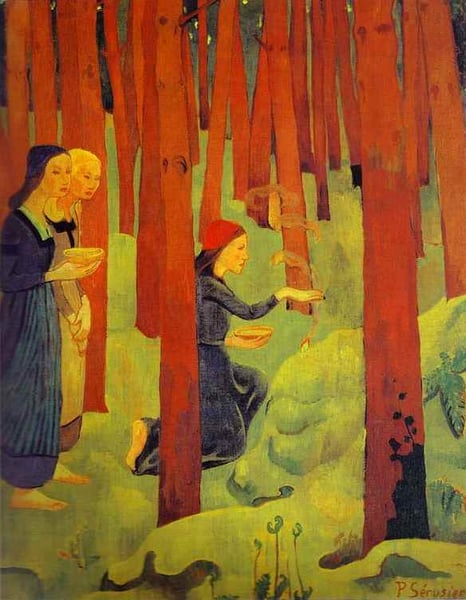
The Incantation (The Holy Wood)
Dettagli
Analisi esperta di The Incantation (The Holy Wood) di Paul Serusier
Stile: Synthetism · Genere: symbolic painting
Expert Analysis: "The Incantation (The Holy Wood)" by Paul Sérusier
Paul Sérusier’s The Incantation (The Holy Wood) stands as a quintessential example of Synthetism, the post-Impressionist style that sought to synthesize outward appearances with the artist’s inner feelings, using bold, flat areas of color, strong outlines, and a deliberate departure from naturalistic detail. Created during Sérusier’s formative years within the Pont-Aven School—where he was deeply influenced by Paul Gauguin—this painting embodies the movement’s core ambition: to convey symbolic meaning through simplified, almost abstract form.
As a symbolic painting, the work moves beyond mere representation. The title itself invokes ritual and mystery: “incantation” suggests a magical or sacred act, while “The Holy Wood” evokes a sacred grove, a space removed from the mundane world. Sérusier uses Synthetist techniques to heighten this otherworldly quality. The composition likely relies on rhythmic, flattening lines and non-naturalistic color to suggest a spiritual or primordial realm—a visual equivalent of the incantation’s hypnotic, summoning power. The figures, possibly women or priestesses, are not individualized but become archetypes, reinforcing the universal, symbolic narrative.
The significance of this work lies in its disciplined application of Synthetist principles to create a modern icon. Rather than illustrating a story, Sérusier constructs a visual symbol that evokes an emotional or metaphysical state. The painting’s flattened space and arbitrary colors (characteristic of Synthetism) reject the illusionism of academic painting, directly linking form to idea. In doing so, The Incantation exemplifies how Sérusier and his circle transformed ordinary landscapes and figures into vehicles for timeless symbolism—a pivotal step toward the expressive abstraction of the 20th century. It remains a key document of the Pont-Aven School’s radical synthesis of nature, emotion, and myth.
Visivamente simili
20 opere con composizione e palette affini
Madeline with the Offering
Paul Serusier
Jeanne d'Arc, or Breton girl spinning
Paul Gauguin
The Youth of Queen Anne
Paul Serusier
The Wait at the Well
Paul Serusier
Jacob's Battle with the Angel
Maurice Denis
Breton Women, the Meeting in the Sacred Grove
Paul Serusier
Celtic Tale
Paul Serusier
Women at the Apple Tree
Tymofiy Boychuk
A Breton Sunday
Paul Serusier
Chestnut Gatherers
Georges Lacombe
The Walk in the Forest
Henri Rousseau
Mognonne Allons Voir si la Rose
Paul Serusier
Le martyre de Saint Sebastien act IV set design
Leon Bakst
The Vision after the Sermon (Jacob wrestling with the Angel)
Paul Gauguin
Procession of the Queen of Sheba (detail)
Piero della Francesca
Milkmaid
Mykhailo Boychuk
Bretons on a Path
Paul Serusier
The Ages of Life
Georges Lacombe
Women Spinning Cotton
Spyros Vassiliou
Afternoon in the Woods
Maurice Denis