Mognonne Allons Voir si la Rose
Dettagli
Analisi esperta di Mognonne Allons Voir si la Rose di Paul Serusier
Stile: Synthetism · Genere: genre painting
Expert Analysis: "Mognonne Allons Voir si la Rose" by Paul Sérusier
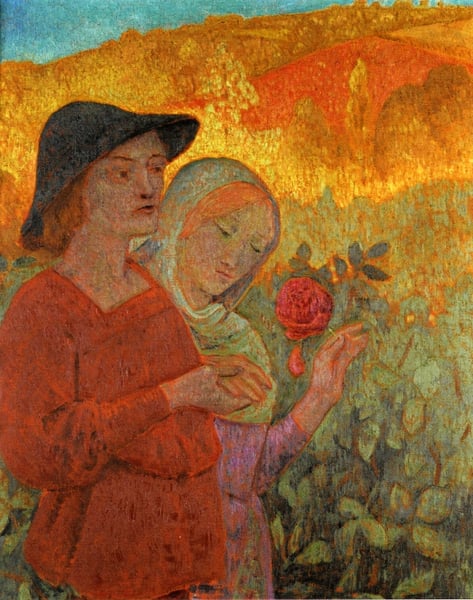
Paul Sérusier’s Mognonne Allons Voir si la Rose is a quintessential example of Synthetism, the avant-garde movement he helped pioneer alongside Paul Gauguin and the Pont-Aven School. While the work is classified as a genre painting, its significance lies not in the mere depiction of everyday life, but in how it transforms that scene into a vehicle for symbolic meaning and formal innovation.
The title directly quotes the opening line of Pierre de Ronsard’s 16th-century poem "Mignonne, allons voir si la rose"—a meditation on the fleeting nature of beauty and youth. Sérusier deliberately transposes this literary memento mori into visual language, using Synthetist principles to subordinate naturalistic description to subjective expression. The “genre” subject—likely a young woman contemplating a rose—is thus elevated from anecdote to universal allegory.
What makes this artwork significant within the Synthetist canon is its radical synthesis of form, color, and idea. Sérusier abandons perspective and modeling in favor of flat, unmodulated patches of pure color, bounded by strong, dark outlines (a technique inspired by cloisonné enamels and Japanese prints). The rose, the woman’s gesture, and the surrounding landscape are not illusions of reality but equivalents of an inner emotional state. Every hue is chosen for its expressive, not descriptive, value: the rose’s red may signify passion and transience, while the background’s ochres and greens create a decorative, tapestry-like surface.
This painting stands as a direct heir to Sérusier’s revolutionary 1888 work The Talisman (created under Gauguin’s guidance), which codified Synthetist doctrine. In Mognonne Allons Voir si la Rose, Sérusier applies that doctrine to a traditional genre scene, demonstrating that even the most ordinary moment could be charged with symbolist weight through formal distillation. The work bridges the gap between Gauguin’s primitivist visions and the later Nabis movement (which Sérusier co-founded), who would carry Synthetist color and abstraction into decorative arts.
Ultimately, this painting is significant because it proves that Synthetism was not merely a style for exotic or religious subjects, but a universal visual language capable of poetic reinterpretation. In fusing a Renaissance lyric with modern painterly abstraction, Sérusier redefines genre painting as a space for both intimate observation and timeless philosophical reflection.
Museum / Gallery
Visivamente simili
20 opere con composizione e palette affini
Girl with black hat
Paula Modersohn-Becker
Bretons on a Path
Paul Serusier
Woman Nursing Her Son
Salvador Dali
The Visitation
Maurice Denis
The Rose Robe
Henri Martin
Two Young Girls among the Flowers
Odilon Redon
Solitude, Huelgoat Landscape
Paul Serusier
A Widow
Paul Serusier
Washerwomen at the Laita River, near Pouldu
Paul Serusier
Alsace or reading monk
Odilon Redon
Bretons
Emile Bernard
Peasant child with pink apron
Paula Modersohn-Becker
Madeline with the Offering
Paul Serusier
Francesca da Rimini and Paolo Malatesta
Lajos Gulacsy
The Madman and the Soldier
Lajos Gulacsy
The Young Mothers
Paul Serusier
Lajos Vajda
Vajda Lajos
The Vision after the Sermon (Jacob wrestling with the Angel)
Paul Gauguin
Who is Silvia
Eleanor Fortescue-Brickdale
Four Breton Women
Paul Gauguin