Analisi esperta di Alnwick Castle, Northumberland di J.M.W. Turner
Stile: Romanticism · Genere: cityscape
Expert Analysis: Alnwick Castle, Northumberland by J.M.W. Turner
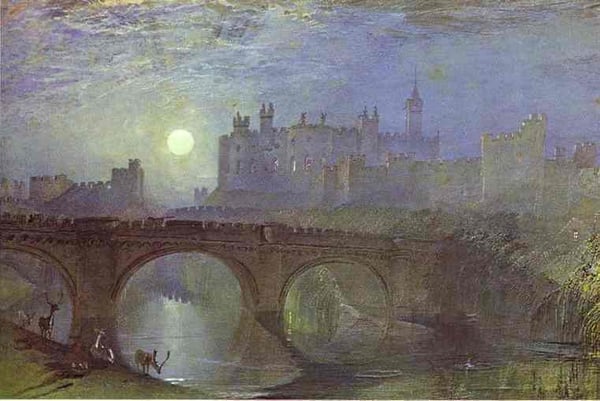
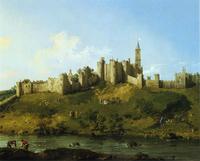
J.M.W. Turner’s Alnwick Castle, Northumberland is a masterful example of Romantic-era cityscape painting that transforms a medieval fortress into a vessel for sublime emotion and historical grandeur. Executed during the height of Turner’s career, the work encapsulates the Romantic preoccupation with nature’s elemental power and the poetic resonance of ancient architecture.
Composition and Atmosphere:
Turner places Alnwick Castle — a sprawling Norman stronghold and seat of the Percy family — not as a static monument but as an organic feature of the landscape. The castle’s towers and battlements emerge from a swirling, atmospheric haze, their solid forms softened by mist and light. A dramatic sky dominates the upper half of the canvas, with clouds breaking to reveal patches of gold and ochre, suggesting either dawn or dusk. This interplay of light and weather evokes the Romantic “sublime” — a sense of awe mixed with the insignificance of humanity before nature and time. The foreground likely includes a river or meadow (as is common in Turner’s Northumbrian views), with small figures or livestock that anchor the scene in everyday rural life, contrasting the timeless castle.
Significance within Romanticism:
Turner’s treatment of Alnwick is significant for its departure from precise topography. Rather than documenting the castle’s architecture in the manner of a factual record, he prioritizes emotional impact. The blurred edges, hazy outlines, and vibrant, almost translucent sky are hallmarks of his later style, where light itself becomes the subject. This aligns with the Romantic ideal of the artist as an interpreter of feeling, not just a transcriber of reality. The castle’s historical associations — with medieval chivalry, power, and the border wars between England and Scotland — are evoked not through narrative, but through mood. Turner invites the viewer to contemplate the passage of time, the endurance of stone, and the fleeting beauty of light.
Place in Turner’s Oeuvre:
While Turner is best known for his seascapes and alpine scenes, his “cityscapes” of castles and cathedrals (such as Norham Castle, Sunrise or The Burning of the Houses of Lords and Commons) function as meditations on the relationship between human ambition and natural forces. Alnwick Castle exemplifies his ability to synthesize architecture and weather into a unified, emotive vision. The painting’s loose brushwork and luminous palette anticipate the proto-impressionist innovations of his late career, while its romanticized medievalism reflects a contemporary nostalgia for a heroic, pre-industrial past.
In summary, Alnwick Castle, Northumberland is significant because it transforms a specific location into a universal Romantic symbol — a place where history, nature, and light converge to stir the imagination. Turner’s genius lies in making a known landmark feel both ancient and immediate, solid and dissolving, grounding the viewer in place while lifting the scene into the realm of the sublime.
Visivamente simili
20 opere con composizione e palette affini
Durham Castle and Framwellgate Bridge, Looking East
Edward Hastings
Caernarvon Castle
J.M.W. Turner
Warwick Castle, England
Jasper Francis Cropsey
On the Regents Canal
Frederick Lee Bridell
Kenilworth Castle
J.M.W. Turner
The Spirit of War
Jasper Francis Cropsey
Conway Castle
William Daniell
A View of Westminster Bridge, Looking West towards Lambeth Palace and Westminster Abbey
David Cox
View of Windsor. Life Guards Approaching the River
David Cox
Rhyddlan Castle and Bridge
Thomas Girtin
Great Fire London
Jan Griffier I
Durham Cathedral and Bridge
Thomas Girtin
The Departure
Thomas Cole
Summer Evening (Caernarvon Castle)
Richard Wilson
Conway Castle
Francis Danby
Old London Brige
J.M.W. Turner
View of Caernarvon Castle with the Menai Strait
Francis Danby
Caernarvon Castle
Richard Wilson
Alnwick Castle
Canaletto
Ancient Rome Agrippina Landing with the Ashes of Germanicus
J.M.W. Turner