
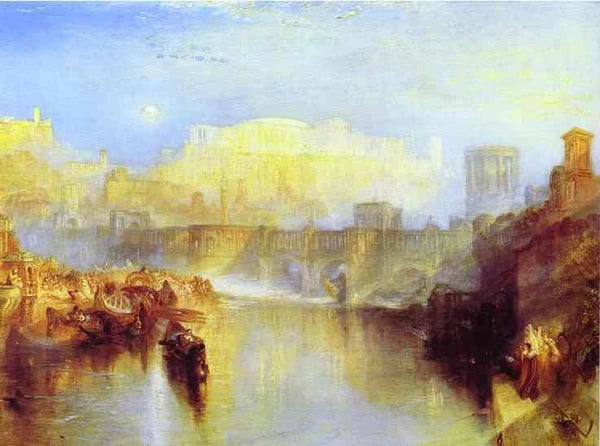
Ancient Rome Agrippina Landing with the Ashes of Germanicus
Dettagli
Analisi esperta di Ancient Rome Agrippina Landing with the Ashes of Germanicus di J.M.W. Turner
Stile: Romanticism · Genere: cityscape
Expert Analysis:
J.M.W. Turner’s Ancient Rome Agrippina Landing with the Ashes of Germanicus is a quintessential Romantic cityscape that transforms a historical narrative into a meditation on sublimity and loss. Working within the Romantic tradition, Turner elevates the genre of the cityscape beyond mere topographical record, infusing it with dramatic emotion and atmospheric grandeur.
Significance within Romanticism:
Turner’s treatment of the ancient Roman subject is distinctly Romantic: rather than offering a precise archaeological reconstruction, he dissolves architectural forms into luminous, swirling light and color. The focus shifts from the literal event—Agrippina carrying the ashes of her slain husband—to the emotional and elemental forces surrounding it. The Tiber, the monumental ruins, and the sky merge into a hazy, almost visionary whole, evoking the passage of time and the fragility of human glory. This approach exemplifies Romanticism’s emphasis on subjective experience, the sublime power of nature, and the evocative interplay of history and emotion.
Significance as a Cityscape:
As a cityscape, the painting is remarkable for its integration of human drama with urban space. Turner uses the ancient city not as a static backdrop but as an active participant in the narrative. The ruins and architecture appear to shimmer and dissolve, suggesting both the enduring legacy of Rome and its inevitable decay. This treatment anticipates later Impressionist approaches to atmosphere and light, while remaining firmly rooted in Romantic ideals of transience and the monumental scale of nature and history.
Key Takeaway:
The artwork is significant for its pioneering fusion of historical genre painting with the Romantic cityscape, where architectural precision is sacrificed for emotional resonance and atmospheric effect. It demonstrates Turner’s mastery of light and color to convey epic themes—mortality, memory, and the sublime—making it a landmark in both his career and the broader Romantic movement.
Museum / Gallery
Visivamente simili
20 opere con composizione e palette affini
Rome, View on the Tiber Looking Towards Mounts Palatine and Aventine
David Roberts
Ancient Italy. Ovid Banished from Rome
J.M.W. Turner
View over Town at Sunset: a Cemetery in the Foreground
J.M.W. Turner
View of Saint Germain en Laye and its Chateau
J.M.W. Turner
Regulus
J.M.W. Turner
Dido Building Carthage
J.M.W. Turner
Departure of the Fleet
J.M.W. Turner

Landscape Composition of Tivoli
J.M.W. Turner
The Bridge and the Castel Sant'angelo in Rome
Claude-Joseph Vernet
Naples
James Webb
Heidelberg
J.M.W. Turner
Caligula's Palace and Bridge
J.M.W. Turner
iew of the Tiber at the Port of Ripa Grande
Gaspar van Wittel
Amboise
John Ruskin
Landscape with a Castle
Rembrandt
The Course of Empire: Destruction
Thomas Cole
The Castle of Alcalá de Guadaíra
David Roberts
Heidelberg Castle, Germany
James Webb
Bay of Naples
Ivan Aivazovsky
Castillo De Alcalá De Guadaira
Jenaro Pérez Villaamil