Analisi esperta di Dido Building Carthage di J.M.W. Turner
Stile: Romanticism · Genere: history painting
Expert Analysis: "Dido Building Carthage" (J.M.W. Turner, 1815)
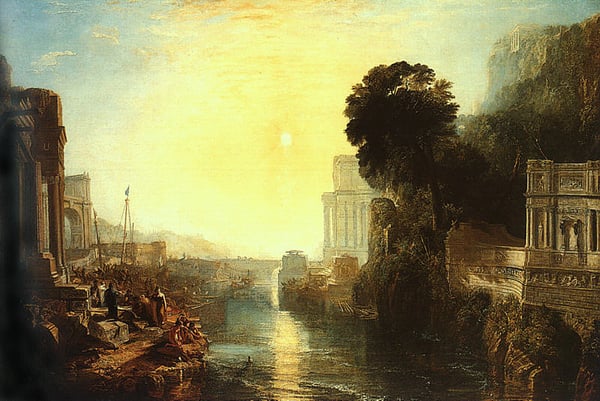
As a towering example of Romanticism, Turner’s Dido Building Carthage redefines the conventions of history painting by subordinating narrative clarity to the sublime power of light and atmosphere. The work depicts the legendary foundation of Carthage, with the figure of Dido overseeing construction amid a vibrant, almost blinding sunrise. This is not a static historical illustration; rather, Turner transforms the scene into a metaphor for imperial ambition and the ephemeral nature of glory, themes central to Romantic introspection.
The painting’s significance lies in its radical handling of color and light. Turner bathes the canvas in a golden, hazy glow, dissolving architectural details and human figures into shimmering reflections. This atmospheric treatment—typical of his later works—imbues the scene with a sense of transience and emotional depth, prioritizing the viewer’s sensory experience over didactic storytelling. In doing so, Turner challenges the academic tradition of history painting, which demanded legible, heroic narratives. Instead, he aligns with Romanticism’s fascination with the sublime, the untamed, and the subjective.
Furthermore, this work anticipates Turner’s lifelong obsession with the interplay of nature, empire, and decay. The ethereal light that seems to both create and consume Carthage suggests that even the greatest civilizations are subject to time’s erosion—a poignant reflection on the Napoleonic era’s upheavals. By making the sun and sky the true protagonists, Turner elevates landscape elements to equal or surpass the human drama, a hallmark of his revolutionary approach. Dido Building Carthage thus stands as a pivotal fusion of history painting and landscape, cementing Turner’s role as the bard of Romanticism’s optical and philosophical intensities.
Museum / Gallery
Visivamente simili
20 opere con composizione e palette affini
Landscape Composition of Tivoli
J.M.W. Turner
The Decline of the Carthaginian Empire
J.M.W. Turner
Moonlit View of an Eastern City
Francis Danby
CAPRICCIO MIT HAFENANSICHT
Luca Carlevaris
Landscape with Figures among Roman Ruins
Jean Barbault
Port at sunset
Claude Lorrain
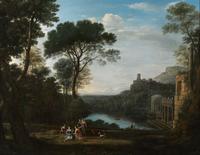
Landscape with the Nymph Egeria
Claude Lorrain
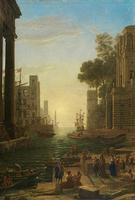
Embarkation of St. Paula Romana at Ostia
Claude Lorrain
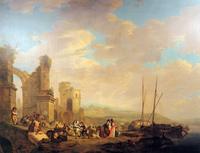
Landscape with coast and ruin
Jacob van Strij
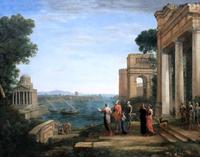
Aeneas and Dido in Carthage
Claude Lorrain
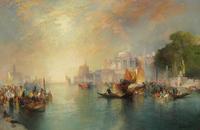
Arabian Nights Fantasy
Thomas Moran
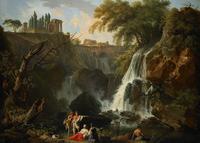
The Cascade at Tivoli
Claude-Joseph Vernet
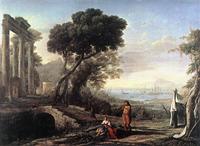
Italian Coastal Landscape
Claude Lorrain
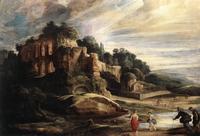
Landscape with the Ruins of Mount Palatine in Rome
Peter Paul Rubens
Caligula's Palace and Bridge
J.M.W. Turner
Landscape Capriccio with Tomb of the Horatii and Curiatii, and the Villa of Maecenas at Tivoli
Richard Wilson
Cows Watering in a Landscape near an Aqueduct
Claude Lorrain
Fantastic mountain landscape
Paul Bril
Golden Bough (after Joseph Mallor William Turner)
Thomas Moran
Tivoli Landscapes (1748) by Joseph Vernet
Claude-Joseph Vernet