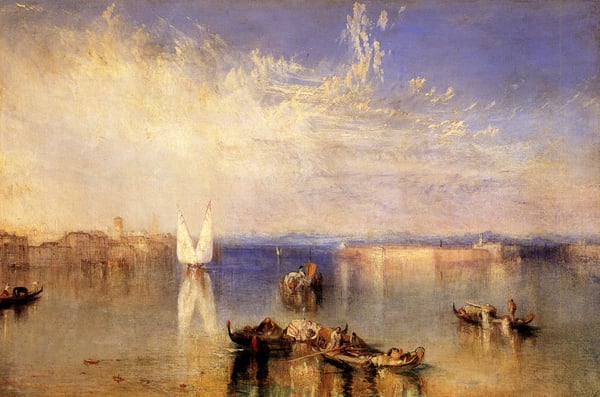
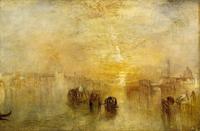
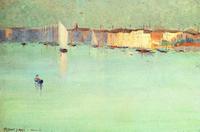
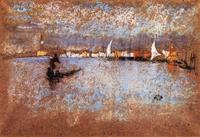
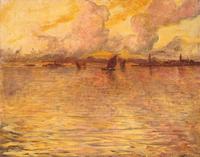
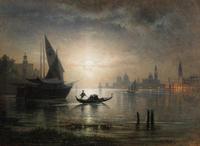
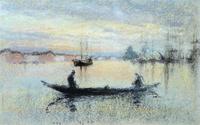
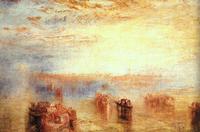
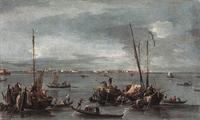
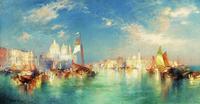
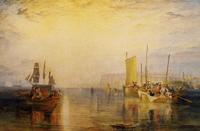
J.M.W. Turner’s Campo Santo, Venice is a quintessential Romantic cityscape that transforms a topographical view into a meditation on light, atmosphere, and transience. As a work of Romanticism, it moves beyond mere documentation of Venice’s architecture to capture the emotional and sensory experience of the city—its luminous canals, hazy horizons, and the interplay of natural and man-made forms. Turner’s handling of light and color is central to the work’s significance: he dissolves solid structures into shimmering reflections and veils of atmosphere, suggesting the fleeting, impermanent quality of beauty. The cityscape genre here becomes a vehicle for Romantic ideals—the sublime power of nature, the poetic decay of ancient sites, and the artist’s subjective vision. Campo Santo, Venice stands as a key example of Turner’s later, more atmospheric style, where the city itself is less a concrete location than a symbol of the Romantic fascination with the luminous and the ethereal.