Analisi esperta di The guidecca Winter Grey and Blue di James McNeill Whistler
Stile: Impressionism · Genere: landscape
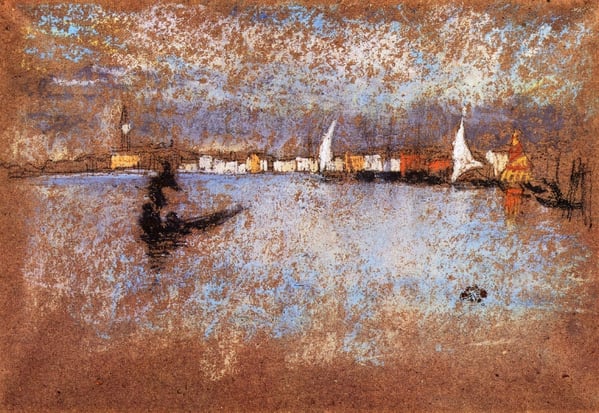
Expert Analysis of "The Giudecca, Winter, Grey and Blue" by James McNeill Whistler
James McNeill Whistler’s The Giudecca, Winter, Grey and Blue is a quintessential example of Impressionist landscape painting that transcends mere topographical record to become a study in atmospheric harmony. Painted during Whistler’s visits to Venice in the late 1870s and early 1880s, this work exemplifies his radical departure from narrative or moralistic art toward a purely aesthetic experience—what he famously called “art for art’s sake.”
Significance within Impressionism and Whistler’s Oeuvre
Unlike many Impressionists who emphasized vibrant, broken color and transient effects of sunlight, Whistler focused on tonal unity and subtle gradations. Here, the restricted palette of greys, blues, and muted whites captures the stillness and damp chill of a Venetian winter. The Giudecca canal is reduced to an arrangement of horizontal bands—water, sky, distant architecture—dissolving into a soft, almost hazy atmosphere. This deliberate suppression of detail in favor of mood aligns Whistler with the Japanese aesthetic he admired, particularly the spare elegance of ukiyo-e prints, which influenced his compositional cropping and flattened perspective.
The Work’s Place in Whistler’s “Nocturnes” and “Arrangements”
Whistler frequently titled his works with musical terms (e.g., Nocturne, Symphony, Arrangement) to emphasize their abstract, non-representational qualities. Although this painting bears a descriptive title, it functions as a visual equivalent of a musical chord—the “Grey and Blue” of the subtitle indicates a deliberate color key. The work’s significance lies in its bridging of plein-air impressionism with the symbolist interest in evoking emotion through tone. By stripping the landscape to its essential muted harmonies, Whistler invites the viewer to experience not a specific place but a sensation: the quiet melancholy of a winter afternoon on the lagoon.
Why It Matters
This painting represents a critical moment when Whistler moved beyond the influence of Courbet and Manet to forge a personal style that prioritized atmosphere over anecdote. It also exemplifies his contribution to the Aesthetic Movement, arguing that a landscape need not tell a story to be meaningful—its value resides in the arrangement of line, color, and light. The Giudecca, Winter, Grey and Blue is therefore a landmark in the evolution of modernism, anticipating the abstract concerns of later 20th-century painting while remaining firmly rooted in the Impressionist fascination with the fleeting moment.
Visivamente simili
20 opere con composizione e palette affini
Note in Flesh Colour: The Guidecca
James McNeill Whistler
View of Venice
James McNeill Whistler
Campo Santo, Venice
J.M.W. Turner
Venetian Nocturne
Glenn Cooper Henshaw
The Grand Canal, Venice
John Henry Twachtman
Early Morning, Venice
Robert Henri
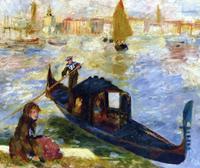
Gondola
Pierre-Auguste Renoir
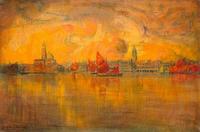
View of Venice from the Sea
Charles Cottet
The Gondola on the Lagoon
Francesco Guardi
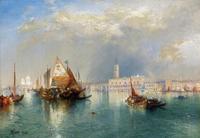
Venice
Thomas Moran
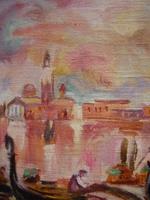
Venice
Corneliu Michailescu
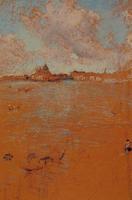
Venetian Scene
James McNeill Whistler
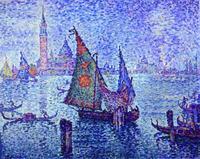
La Voile verte
Paul Signac
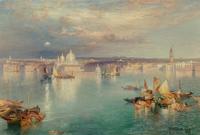
Venetian Scene
Thomas Moran
Giudecca, la Donna della Salute and San Georgio
J.M.W. Turner
View of Venice. The Ducal Palace, Dogana and Part of San Giorgio
J.M.W. Turner
Barche De Pesche, Venezia
Antonietta Brandeis
Venice - Boats on the Dogana
Oskar Kokoschka
Venice from the Tower of San Giorgio
Thomas Moran
Venice
John Henry Twachtman