Expert analysis of Claude Lorrain’s Italian Coastal Landscape
Style: Classicism · Genre: landscape
Expert Art Analysis: "Italian Coastal Landscape" by Claude Lorrain
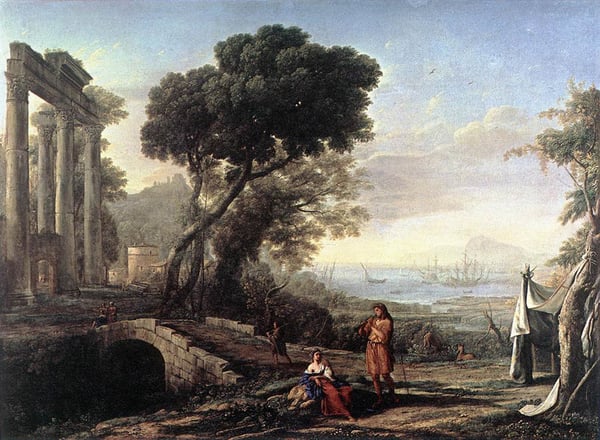
Claude Lorrain’s Italian Coastal Landscape stands as a quintessential example of Classicism in landscape painting, embodying the period’s pursuit of ideal beauty, order, and harmony. Within the Classicism style, landscapes were not mere topographical records but elevated to convey a sense of timeless, poetic serenity—often infused with references to antiquity or mythological narratives.
Significance within Classicism:
Lorrain masterfully balances composition through a structured, receding perspective: foreground framing elements (trees, ruins), a luminous middle distance (the coastal plain), and a vast, atmospheric horizon. This tripartite arrangement—grounded in Renaissance perspective theory—creates a rational, measured space that feels both natural and idealized. The soft, golden light suffusing the scene is a hallmark of Lorrain’s technique, known as sfumato luminoso, which unifies the landscape into a tranquil, pastoral mood. Such light effects were later emulated by classicizing artists and became a defining feature of the French Baroque landscape tradition.
Genre Significance:
As a landscape, the work elevates nature from background to subject, yet it remains disciplined by classicist principles: no dramatic weather or wild terrain; instead, a placid sea, gently sloping hills, and architectural remnants (likely Roman) evoke a “golden age” of pastoral bliss. This idealization reflects Classicism’s core belief that art should perfect nature, not merely copy it—a concept Lorrain refined throughout his career, influencing generations from Poussin to Turner.
In essence, Italian Coastal Landscape exemplifies how Classicism transformed landscape into a vehicle for intellectual and aesthetic harmony, making Lorrain a pivotal figure in the history of Western art.
Museum / Gallery
Visually similar
20 works with related composition and palette
Coast Scene with Europa and the Bull
Claude Lorrain
The pressing of grapes
Claude Lorrain
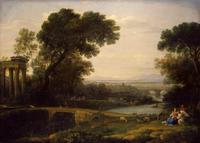
Landscape with the Rest on The Flight into Egypt
Claude Lorrain
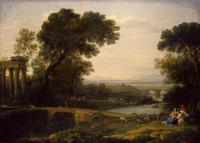
Landscape with Rest in Flight to Egypt
Claude Lorrain
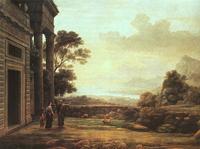
The Expulsion of Hagar
Claude Lorrain
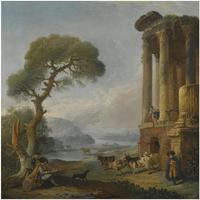
A River Landscape With An Artist Sketching Beneath A Ruined Temple, Possibly The Temple Of The Sibyl At Tivoli
Hubert Robert
Landscape
Abraham Begeyn
Landscape with the finding of Moses
Claude Lorrain
Bandits among Ruins
Pierre-Antoine Patel
Landscape with the Nymph Egeria
Claude Lorrain
Roman Ruins Landscape
Paul Bril
Landscape with Paris and Oenone
Claude Lorrain
Römische Ruinenlandschaft
Paul Bril
Landscape with Flight into Egypt
Claude Lorrain
Landscape with St. James in Patmos
Nicolas Poussin
View of Seaport
Claude Lorrain
[Unkown]
Károly Markó the Elder
Landscape with the Temple of Vesta in Tivoli
Adam Elsheimer
Capriccio mit antiken Ruinen und Personenstaffage
Isaac de Moucheron
Landscape with Apollo Guarding the Herds of Admetus
Claude Lorrain