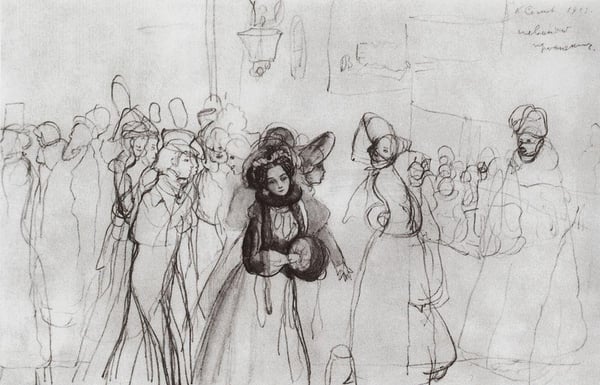
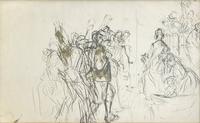
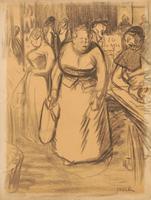
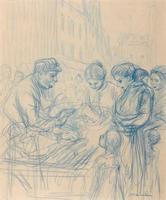
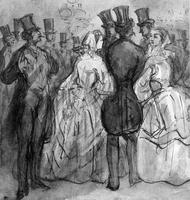
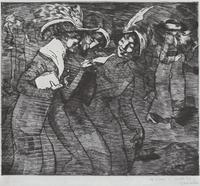
This study by Konstantin Somov, a leading figure in Russian Symbolism and a member of the "World of Art" group, is significant precisely because it functions as a sketch and study—a liminal space where literary narrative meets visual translation. The work’s importance lies not in a polished finish, but in its process-oriented approach to illustrating Nikolai Gogol’s Nevsky Prospect, a story about the deceptive, phantasmagoric nature of urban life.
Within the Symbolist milieu, the link between visual art and literature was paramount. Somov’s sketch captures the ambiguous, dreamlike atmosphere of Gogol’s tale rather than a literal scene. The unfinished quality of the study embodies the Symbolist preoccupation with the suggestion of meaning over explicit statement. Furthermore, Somov was renowned for blending Rococo elegance with a modern, often melancholic tension; this preparatory work likely reveals his characteristic fusion of 18th-century porcelain delicacy with a darker, psychological undercurrent—a hallmark of his style.
As a study, it offers a rare glimpse into Somov’s method of translating Gogol’s urban illusions into line and shadow, making it a key document for understanding how Russian Symbolism reconciled historical pastiche with contemporary literary angst.