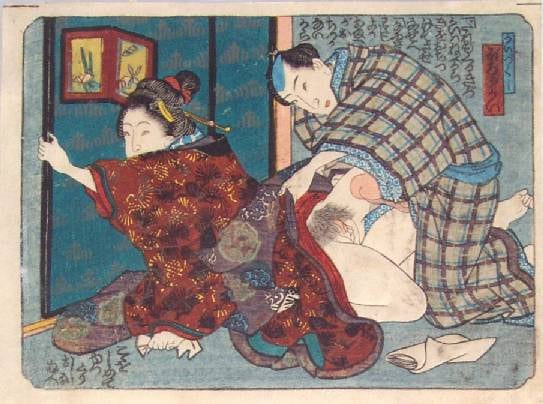
Utagawa Kunisada sanatçısının Closing the Screen eseri hakkında uzman analizi
Tarz: Ukiyo-e · Tür: nude painting (nu)
Expert Analysis: "Closing the Screen" by Utagawa Kunisada
Within the late Edo period, Utagawa Kunisada (also known as Toyokuni III) was a dominant force in ukiyo-e, celebrated for his actor prints, bijin-ga (pictures of beautiful women), and occasional forays into shunga (erotic imagery). "Closing the Screen" is a striking example of the nu genre—a rare and often subtly censored category in ukiyo-e that depicts nudity or intimate moments, typically veiled by the conventions of the time.
Significance within Ukiyo-e and the nu Genre:
-
Mastery of Line and Suggestive Elegance: Kunisada employs his characteristic fluid, calligraphic linework to define the soft contours of the female form without overt explicitness. The composition’s title, "Closing the Screen," is itself a narrative device: the screen both reveals and conceals, creating a tension between modesty and vulnerability. This interplay with the physical object—a folding screen—is a hallmark of ukiyo-e’s ability to embed eroticism within everyday domestic settings.
-
Subversion of Censorship: During Kunisada’s era, strict censorship laws under the Tenpō Reforms (1842–1843) banned explicit erotic prints. Artists circumvented this by producing “nu” works that hinted at nudity through partially draped cloth, folded screens, or turned backs. Here, the act of closing the screen implies an intimate space, allowing the viewer to imagine what is hidden. Kunisada’s skill lies in suggesting more than he shows, making the work a sophisticated response to artistic repression.
-
Psychologically Charged Composition: Unlike the overt theatricality of his kabuki prints, this piece captures a quiet, voyeuristic moment. The woman’s pose—perhaps adjusting a garment or turning away—focuses attention on the curve of her spine and the fall of her hair, emphasizing the tactile sensuality of flesh against silk. The screen’s vertical panels echo the woodblock’s own grid, reinforcing the idea of layered realities: public vs. private, seen vs. unseen.
-
Color Palette and Texture: Kunisada’s use of rich, muted tones—deep indigos, subtle ochres, and pearly whites—enhances the intimacy. The absence of bold outlines on the skin (a technique called bokashi or gradation) softens the figure, distinguishing it from the more graphic shunga of earlier masters like Utamaro or Hokusai. This restraint aligns with the refined aesthetic of the later ukiyo-e period, where emotional nuance often outweighed explicit detail.
In the broader context of ukiyo-e, "Closing the Screen" stands as a testament to Kunisada’s versatility—proving that even under censorship, he could produce works of quiet eroticism and technical brilliance. The print invites contemplation of the boundary between art and desire, a theme that resonates with the fleeting pleasures (ukiyo) central to the genre’s philosophy.
Görsel olarak benzer
İlişkili kompozisyon ve renk paletine sahip 20 eser
The Hand Mirror
Utagawa Kunisada
The High-ranking Courtesan
Utagawa Kunisada
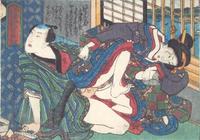
Before the Window
Utagawa Kunisada
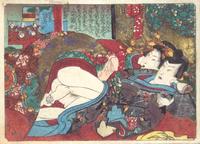
Foreplay Under the Futon
Utagawa Kunisada
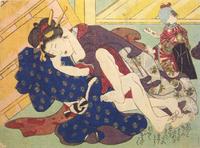
Beneath the Stairs
Utagawa Kunisada
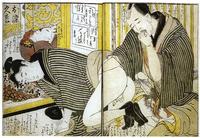
Client Lubricating a Prostitute
Kitagawa Utamaro
The Letter
Utagawa Kunisada
The Samurai
Utagawa Kunisada
The Book
Utagawa Kunisada
The Red and Gold Blanket
Utagawa Kunisada
A married man and a spinster
Kitagawa Utamaro
Prelude to Desire
Kitagawa Utamaro
Love on the Kamo River
Keisai Eisen
Rape scene
Utagawa Kuniyoshi
Masturbation and voyeurism
Katsushika Hokusai
The Kiss
Kitagawa Utamaro
Prelude of desire
Kitagawa Utamaro
One Hundred Stories of Demons and Spirits
Kitagawa Utamaro
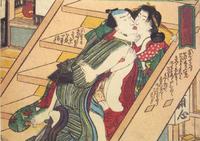
On the Stairs
Utagawa Kunisada
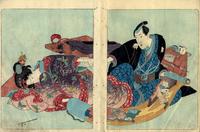
Four seasons: Spring, Summer, Autumn, Winter
Utagawa Kunisada