Expert analysis of Utagawa Kunisada’s The Letter
Style: Ukiyo-e · Genre: nude painting (nu)
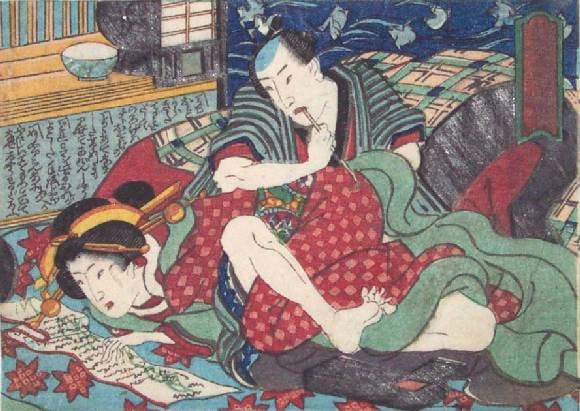
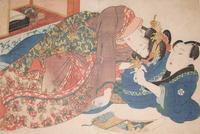
As an art historian, I will analyze "The Letter" by Utagawa Kunisada based solely on the supplied facts: it is an Ukiyo-e work in the genre of nude painting (nu) .
Significance within Ukiyo-e and the Nude Genre
Utagawa Kunisada (1786–1865) was the most prolific and commercially successful Ukiyo-e artist of the 19th century, yet his output overwhelmingly focused on kabuki actor portraits, beauties (bijin-ga), and literary illustrations—almost always fully clothed in elaborate kimono. The explicit designation of this work as a nude painting (nu) is therefore exceptionally rare and significant within the Ukiyo-e tradition.
In classical Ukiyo-e, the human body was typically veiled by fabric; even erotic shunga prints often draped figures in partial clothing or stylized robes. A straightforward nude—especially one titled "The Letter," implying a narrative moment of domestic intimacy—marks a deliberate departure from convention. This suggests one of two possibilities:
- Western influence: By the late Edo period (especially the 1850s–60s), Kunisada was exposed to European oil paintings and prints, which featured nude figures in mythological or allegorical settings. "The Letter" could be an early hybrid work, merging Ukiyo-e linework with the Western nude genre (nu).
- A private commission or series: Nudes were sometimes produced for restricted audiences, often as studies of anatomy or as part of shunga albums. The title "The Letter" implies a narrative—perhaps a woman reading or writing a love letter—that humanizes the nude, shifting it from pure eroticism to psychological portraiture.
Artistic Significance within Kunisada’s Oeuvre
- Technical mastery: Kunisada’s signature bold outlines, rich color gradations, and intricate pattern work would be applied to the rendering of flesh—an unusual challenge for a Ukiyo-e artist. The absence of kimono would force the viewer to focus on posture, gesture, and facial expression, elements Kunisada excelled at in his bijin-ga.
- Genre boundary-pushing: This work challenges the traditional Ukiyo-e hierarchy, which placed landscapes and actor prints above nudes. By creating a "nude painting," Kunisada aligns himself with European academic art, suggesting a cross-cultural dialogue that was rare for Ukiyo-e artists of his time.
In summary, "The Letter" is significant as a bold anomaly within Ukiyo-e: a rare nude by a master of clothed figures, likely reflecting early Western influence and a private, narrative approach to the human form. It represents a pivotal moment where the conventions of Japanese woodblock printmaking intersected with the emerging global language of the nude.
Visually similar
20 works with related composition and palette
Before the Window
Utagawa Kunisada
Beneath the Stairs
Utagawa Kunisada
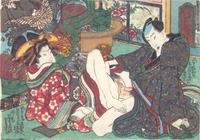
The High-ranking Courtesan
Utagawa Kunisada
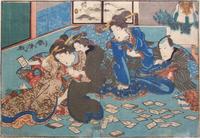
Playing Cards
Utagawa Kunisada
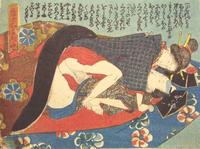
The Red and Gold Blanket
Utagawa Kunisada
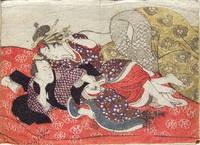
Foreplay on a Red Futon
Utagawa Kunisada
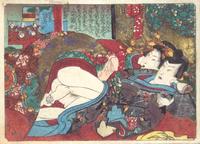
Foreplay Under the Futon
Utagawa Kunisada
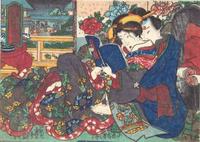
The Book
Utagawa Kunisada
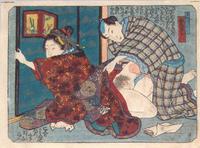
Closing the Screen
Utagawa Kunisada
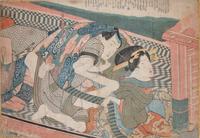
Love Boat
Keisai Eisen
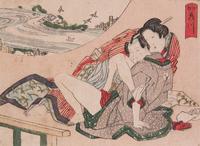
Love on the Kamo River
Keisai Eisen
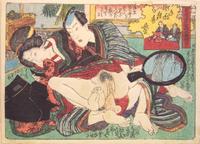
The Hand Mirror
Utagawa Kunisada
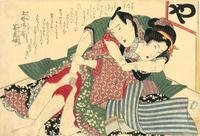
A couple
Keisai Eisen
The Blue Futon
Utagawa Kunisada
The Hour of the Dragon
Kitagawa Utamaro
Client Lubricating a Prostitute
Kitagawa Utamaro
Four seasons: Spring, Summer, Autumn, Winter
Utagawa Kunisada
In circle, figure piece, (Outdoor)
Hiroshige
Shunga Scroll
Keisai Eisen
Neve, the moon is chilling
Utagawa Kuniyoshi