Expert analysis of Paul Signac’s The Demolisher
Style: Pointillism, Neo-Impressionism · Genre: genre painting
Expert Analysis of "The Demolisher" by Paul Signac
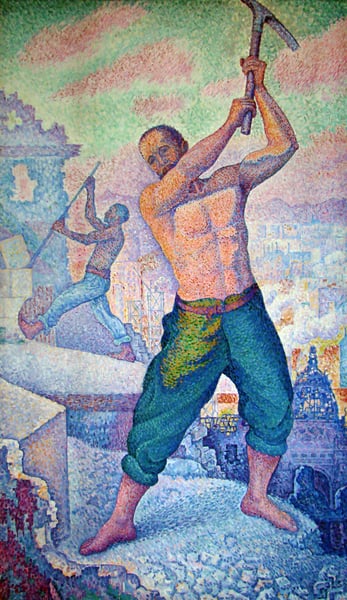
Paul Signac’s “The Demolisher” is a compelling example of how Neo-Impressionism—and its signature technique, Pointillism—could be harnessed to depict modern, everyday labor with both scientific rigor and expressive power. Painted in the late 19th century, this work merges a genre scene of a manual worker with the systematic color theory that defined the movement.
Technical and Stylistic Significance
True to Pointillist practice, Signac constructs the composition entirely from small, distinct dots of pure pigment. These dots are not mixed on the palette but are intended to blend optically in the viewer’s eye, producing a luminance and vibrancy unattainable through traditional mixing. In “The Demolisher,” this technique serves a dual purpose: it captures the shimmering atmosphere of an outdoor worksite—the dust, the sunlight, the heat—while simultaneously imposing an almost scientific order on a chaotic subject. The fragmentation of color into discrete units mirrors the demolition itself: breaking down a solid structure into its constituent parts.
Subject and Social Context
Signac was deeply committed to anarchist ideals and believed in the dignity of labor. Unlike the pastoral or leisure scenes favored by many Impressionists, “The Demolisher” focuses on a proletarian figure—a man wielding a pickaxe against a brick wall. The worker is not a passive or romanticized peasant; he is an active agent of change, clearing away the old to make room for the new. This aligns with Signac’s broader interest in modernity and progress. The painting thus functions as a genre scene that elevates manual labor to a subject worthy of avant-garde treatment.
Composition and Color Harmony
Signac organizes the canvas with a strong diagonal line formed by the worker’s tool and the collapsing wall, creating a dynamic tension between stability and collapse. The palette is dominated by warm ochres, oranges, and yellows (the wall, the sunlit dust) contrasted with cool blues and violets in the shadows—a classic complementary color pair that enhances vibrancy. Each dot is carefully placed to maintain overall harmony while suggesting the gritty texture of brick and rubble. The worker’s silhouette is defined not by outlines but by the density and direction of the dots, a hallmark of Neo-Impressionist figure-ground integration.
Significance Within the Movement
“The Demolisher” is significant because it demonstrates that Pointillism was not merely a decorative or optical exercise. Signac, more than his predecessor Georges Seurat, used the technique to engage with contemporary social realities. The painting bridges the gap between high theory and everyday life, proving that the systematic application of color could depict not just static landscapes or bourgeois leisure but also the physical, dirty work of urban transformation. It stands as a testament to Neo-Impressionism’s versatility and to Signac’s belief that art could be both scientifically precise and socially conscious.
In summary, “The Demolisher” is a masterful synthesis of Pointillist technique and modern genre painting, capturing the energy of labor while advancing the color theories that defined the Neo-Impressionist movement.
Museum / Gallery
Visually similar
20 works with related composition and palette
Au temps d'harmonie (L’âge d’or n’est pas dans le passé, il est dans l’avenir)
Paul Signac
Au Temps D’harmonie
Paul Signac
Ferro
Candido Portinari
Les Batteurs De Pieux
Maximilien Luce

A man with axe
Paul Gauguin
Egry József, Balatoni Halász
Egry József
Czene Béla, Krumpli Szedők 1944
Czene Béla
Czene Bela , Almaszedő, 1942
Czene Béla
Lavoro (il taglialegna)
Jan Toorop
Sämann Und Teufel. Zweite Fassung
Albin Egger-Lienz
On the dock
Alessandro Milesi
Untitled
Grégoire Michonze

Czene Béla, Munkásverseny
Czene Béla
Excursion
Henri-Edmond Cross
Lumberjack
Ferdinand Hodler

Untitled
Marevna (Marie Vorobieff)
Young Bathers
Georg Pauli
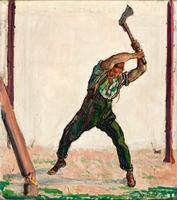
The Woodman
Ferdinand Hodler
Exposition de Peintures- Dessins et Gravures
Theophile Steinlen
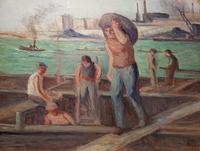
Les Débardeurs
Maximilien Luce