Expert analysis of Paul Signac’s Woman by a lamp
Style: Pointillism, Neo-Impressionism · Genre: portrait
Artwork Analysis: Woman by a Lamp (c. 1887–1890) by Paul Signac
As a leading figure of Neo-Impressionism, Paul Signac refined and codified the Pointillist technique pioneered by Georges Seurat. Woman by a Lamp is a compelling example of how this scientific approach to color and light could be applied to an intimate interior portrait, transforming a quiet domestic scene into a vibrant optical experiment.
Technical Mastery & Color Theory
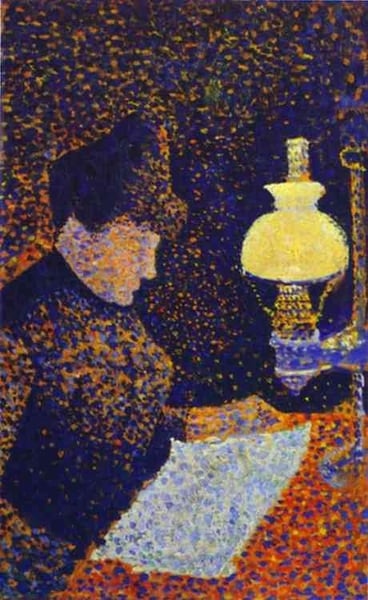
True to Signac’s method, the portrait is constructed from meticulous, often comma-like dots of pure pigment. Rather than mixing colors on a palette, the artist relies on the viewer’s eye to optically blend the hues. This is especially evident in the treatment of the lamp’s glow: warm yellow, orange, and even tiny dots of pink radiate outward, cooled by contrasting strokes of blue and violet in the shadows. The juxtaposition demonstrates the Neo-Impressionist principle of simultaneous contrast, where complementary colors heighten each other’s intensity.
Interplay of Artificial and Ambient Light
The painting’s significance lies in its sophisticated handling of artificial illumination—a relatively modern subject at the time. The lamp becomes the composition’s emotional and structural anchor. Signac does not simply paint a light source; he maps its chromatic interference across the woman’s face, hands, and surrounding drapery. Her profile is outlined in deep blues and purples, while the lamp side is charged with yellows, greens, and pale pinks. This chromatic division creates a sense of volume and atmosphere without resorting to traditional chiaroscuro.
Genre Within the Avant-Garde
Although Neo-Impressionism is often associated with landscapes and seascapes, Woman by a Lamp asserts the style’s suitability for portraiture. The subject remains anonymous, her focus turned inward, perhaps reading or sewing. This quietude contrasts with the kinetic energy of the brushwork—each dot a deliberate particle of light and color frozen in time. The portrait thus bridges the immediacy of Impressionist observation with the rigorous structural logic of Neo-Impressionist science.
Legacy and Significance
This work exemplifies Signac’s transition from Seurat’s strict Pointillism toward a freer, slightly more expressive use of the technique. The dots are visible as separate entities, inviting the viewer to step back and optically complete the image. Woman by a Lamp stands as a testament to how Neo-Impressionism could distill modern life—the quiet glow of gaslight, the solitude of a figure—into a symphony of color, making the ordinary radiant through optical precision.
Museum / Gallery
Visually similar
20 works with related composition and palette
Three Women at the Table by the Lamp
August Macke
Lamplight
Victor Pasmore
Still Life with Lamp
Marc Chagall
The Smolensk Newspaper
Marc Chagall
Inspiration
Nikolay Bogdanov-Belsky
Young woman near lamp
Pierre Bonnard
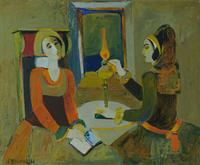
Memory
Minas Avetisyan
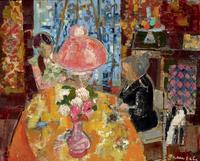
Under the lamp
Emilio Grau Sala
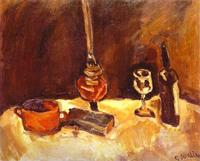
Still Life with Lamp
Chaim Soutine
НАТЮРМОРТ С ЛАМПОЙ
Vlad Avanesov
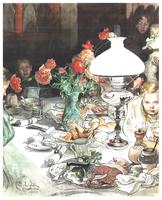
Around the Lamp at Evening
Carl Larsson
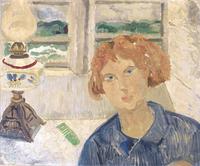
Girl and Lamp in a Cornish Window
Christopher Wood
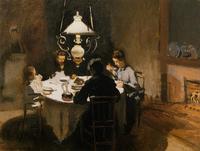
The Dinner
Claude Monet
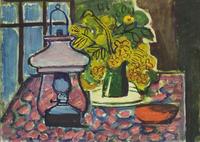
Still Life with Lamp
Margit Selska
Portrait of Josep Cardona
Pablo Picasso
Portrait of Meijer de Haan by Lamplight
Paul Gauguin
Portrait of Émile Verhaeren
Louis Hayet
Three Lamps
Juan Gris
The Dinner
Claude Monet
Iltahetki
Elin Danielson-Gambogi