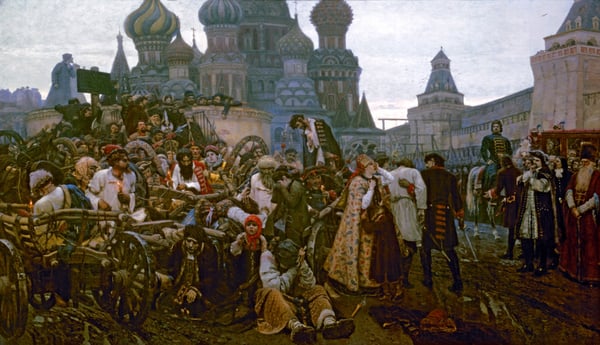
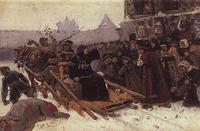
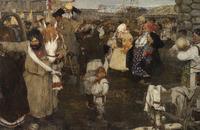
"Morning of the Strelets’ (Streltsi) Execution" by Vasily Surikov is a landmark of 19th-century Russian Realism, distinguished by its unflinching depiction of historical tragedy and its profound emotional depth. The work portrays the aftermath of the Streltsy uprising of 1698, when Tsar Peter the Great brutally suppressed the rebellious musketeer corps. Surikov does not focus on the violence of the executions themselves but on the psychological tension preceding them: a crowd of condemned men, their families, and the implacable figure of Peter on horseback.
What makes this painting significant is Surikov’s masterful blending of documentary-like realism with a deeply humanist perspective. The composition is densely packed with individualized figures—each strelets displays a unique posture of defiance, grief, or resignation, while the grieving women and children create a swirling, emotionally charged foreground. Surikov’s use of muted, earthy tones and stark contrasts (especially the white shirts of the condemned against the dark masses of the crowd) heightens the somber atmosphere. The lone figure of the tsar, austere and detached, serves as a chilling counterpoint to the human suffering below.
Within the tradition of history painting, Surikov broke away from academic idealization. Instead, he elevated the common person—the strelets and his family—as the true subject of history. This work is pivotal in Russian art for its synthesis of national identity, epic scale, and compassionate realism, influencing later generations of painters who sought to capture the moral weight of historical events.