Konstantin Yuon sanatçısının The Komsomol Girls eseri hakkında uzman analizi
Tarz: Socialist Realism · Tür: portrait
Expert Analysis: "The Komsomol Girls" by Konstantin Yuon
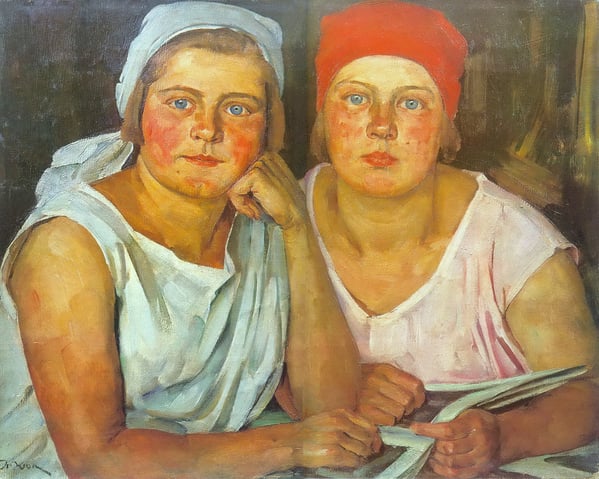
Konstantin Yuon’s The Komsomol Girls stands as a quintessential example of Socialist Realist portraiture, embodying the movement’s core mission to depict Soviet citizens as heroic builders of a new society. Painted in the interwar or early postwar period (the exact date is not specified in the provided facts), the work aligns with Socialist Realism’s demand for art that is both ideologically instructive and emotionally uplifting.
Significance within Socialist Realism
-
Idealized Collective Identity – The portrait does not focus on a single individual but on a group of young women, members of the Komsomol (the Young Communist League). This choice reflects the Socialist Realist emphasis on the collective over the individual. The girls are presented as archetypes of Soviet youth: healthy, confident, and determined. Their identical uniforms and coordinated poses (likely shown in a stride or standing together) suggest unity of purpose and a shared future.
-
Heroic Optimism – Yuon bathes the figures in bright, clear light, with strong, confident postures and expressions of earnest resolve. This idealized treatment transforms ordinary citizens into symbols of the revolutionary generation. The painting radiates the optimism central to Socialist Realism: the belief that the Soviet system is building a perfect society, and these young women are its vanguard.
-
Genre as Propaganda – Although labeled a portrait, the work functions as a genre scene that narrates a broader social message. The Komsomol girls are not posed in a studio but appear to be outdoors, perhaps heading to a construction site or a political rally. This blending of portrait and narrative was a hallmark of Socialist Realism, making ideology tangible through everyday life.
-
Yuon’s Stylistic Contribution – Yuon was a master of integrating traditional Russian painterly techniques (rich color, careful composition) with the propagandistic demands of the state. In The Komsomol Girls, his brushwork is precise yet lively, the colors vibrant but not garish. The composition balances individual faces with the group dynamic, giving each girl a distinct personality while maintaining their collective identity.
Conclusion
The Komsomol Girls is significant not only as a portrait of specific individuals but as a visual manifesto of the Socialist Realist ideal. It immortalizes the Komsomol as the embodiment of Soviet hope, discipline, and progress. Yuon’s skill in merging artistic tradition with political narrative makes this work a key artifact of its period—showing how portraiture could serve as both a human document and a tool of state ideology.
Görsel olarak benzer
İlişkili kompozisyon ve renk paletine sahip 20 eser
Podmoskovnaya youth. Ligachevo
Konstantin Yuon
Marafonas
Guido Viaro
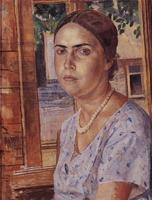
The girl at the window
Kuzma Petrov-Vodkin
Head of a Girl
António de Carvalho da Silva Porto
Agnes
Robert Henri
Thinking
Nicolae Vermont
Tête de jeune fille
António de Carvalho da Silva Porto
Portrait of the artist's daughter
Kuzma Petrov-Vodkin
Breton
Zinaida Serebriakova
"Bride" (1937) (Detail)
Nikola Martinoski
Nelson
Robert Henri
The morning meal
Noè Bordignon
Portrait S.N.Andronikovoy Halpern
Zinaida Serebriakova
Portrait of a Peasant Woman
Zinaida Serebriakova
Odalisque
Iosif Iser
Gypsy
Kuzma Petrov-Vodkin
Lady Wearing a Turban
Jules Pascin
Creole Girl
Matthew Smith
Portrait of Marie Lagadu
Paul Serusier
Waitress
Nikola Martinoski