Expert analysis of James Tissot’s Caricature of Edward, Prince of Wales
Style: Realism · Genre: caricature
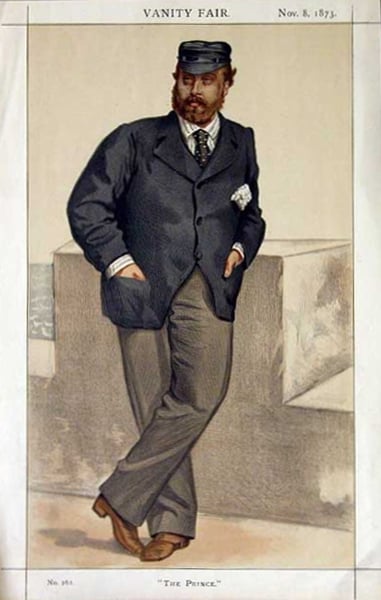
Expert Art Historical Analysis: Caricature of Edward, Prince of Wales by James Tissot
James Tissot is most celebrated for his meticulously detailed, Realist depictions of fashionable society in the late 19th century—scenes of leisure, romance, and bourgeois elegance that often verge on the anthropological in their precision. Yet this artwork, a Caricature of Edward, Prince of Wales, represents a fascinating and lesser-known intersection of Realism with the genre of caricature, making it significant for several reasons.
Realism Meets Satire: The Fusion of Genres
Within the Realist tradition, Tissot adhered to an almost photographic attention to textures, fabrics, and physiognomy. In this caricature, however, he applies that same exacting Realist technique to a subject that is deliberately exaggerated for comic or critical effect. By refusing to abandon realistic rendering of clothing, posture, and setting while distorting facial features or proportions, Tissot creates a hybrid work that subverts both genres: the caricature gains the gravity of documentary observation, and the Realist portrait gains the sharp edge of social commentary.
A Prince as Everyman: Political and Social Significance
The subject—Edward, Prince of Wales, the future King Edward VII—was one of the most scrutinized public figures of the era, known for his playboy reputation, fashion influence, and diplomatic charm. Tissot’s caricature likely captures not just a likeness but a critique of Edward’s well-known indulgences and his role as a symbol of the monarchy’s modernity (or its flaws). By employing Realism’s factual vocabulary, Tissot lends his satire a veneer of objectivity, forcing viewers to confront the reality behind the royal image. This was a bold move for an artist who typically painted polite society; here, he turns that same observational skill into a political statement.
Placement Within Tissot’s Oeuvre and Period Context
Tissot’s career included a period of caricature work for publications (notably Vanity Fair), and this piece exemplifies his ability to move between high art and popular satire without compromising his Realist foundations. The work stands as a document of the late 19th-century fascination with celebrity and the power of visual media to shape public perception. In an era when realism was often seen as a neutral record, Tissot proves that even the most faithful style can be wielded for humor and critique.
Conclusion
The significance of Caricature of Edward, Prince of Wales lies in its fusion of two seemingly opposed modes: the painstaking accuracy of Realism and the deliberate distortion of caricature. It challenges the assumption that realism is merely earnest documentation, revealing it as a flexible tool for persuasion and wit. It also offers a rare glimpse of a major artist engaging directly with political satire, making it a vital work for understanding both Tissot’s range and the broader cultural role of Realism in the 19th century.
Visually similar
20 works with related composition and palette
Brothers Prohaska
Josef Kriehuber
Professor G. W. L. Marshall-Hall
Tom Roberts
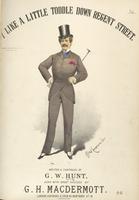
Cover design for G.H. MacDermott's song ''I Like A Little Toddle Down Regent Street''
Alfred Concanen
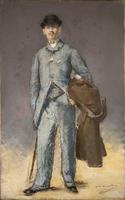
René Maizeroy
Edouard Manet
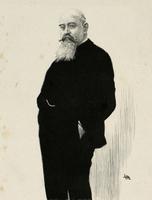
Giuseppe Giacosa
Leopoldo Metlicovitz
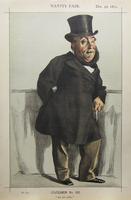
Statesman No.102° - Caricature of William Henry Gregory
James Tissot
Ramón De Errazu
Raimundo de Madrazo
Dilke, Charles Wentworth
James Tissot
Cover design for Dont Make a Noise or Else You'll Wake the Baby - Sung with the Greatest Success by George Leybourne
Alfred Concanen
Man of the day No.36° - Caricature of Matthew Arnold
James Tissot
Portrait of Gustave Geffroy
Marie Bracquemond
Charles Fouques Duparc
Henri Regnault
Statesman No.090° - Caricature of George William Pierrepont Bentinck M.P.
James Tissot
Statesman No.101° - Caricature of George Cavendish Bentinck
James Tissot
Man of the day No.32° - Caricature of George Whyte Melville
James Tissot
Caricature of Anthony John Mundella
James Tissot
Self-portrait with skull-cap
Edouard Manet
Statesman No.094° - Caricature of Alderman Andrew Lusk M.P.
James Tissot
Harper Pennington
James McNeill Whistler
Man of the day No.35° - Caricature of John Pender
James Tissot