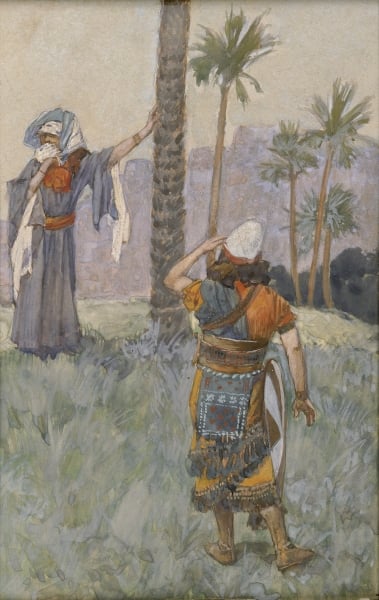
James Tissot sanatçısının Deborah Beneath the Palm Tree eseri hakkında uzman analizi
Tarz: Symbolism · Tür: religious painting
Expert Analysis of "Deborah Beneath the Palm Tree" by James Tissot
Given the supplied facts—a religious painting executed in the Symbolist style—this work holds a distinctive place in James Tissot’s oeuvre and in late‑19th‑century religious art. The subject, drawn from the Book of Judges (Judges 4:4–5), depicts the prophetess and judge Deborah seated under a date‑palm, where she rendered decisions for the Israelites. Tissot’s treatment transforms this biblical narrative into a profound Symbolist meditation.
Significance within the Symbolist movement:
While Symbolism often favored dreamlike, ambiguous, or mythological subjects, Tissot anchored his imagery in meticulous archaeological and ethnographic detail. In Deborah Beneath the Palm Tree, the palm—a traditional symbol of justice, peace, and divine presence—becomes more than a stage prop. Its towering, spreading fronds envelop Deborah, creating a natural canopy that visually elevates her role as God’s appointed leader. The subdued, earthy palette and the figure’s meditative pose align with Symbolism’s emphasis on inner emotion and spiritual truth, rather than literal historical reenactment. The work thus bridges Tissot’s earlier career as a society portraitist and his later immersion in biblical themes, using symbolic vegetation and composition to suggest the sacredness of everyday judgment.
Significance as a religious painting:
In the context of late‑19th‑century religious art, which often oscillated between academic historicism and sentimental piety, Tissot’s approach is marked by quiet reverence and human intimacy. Deborah is not shown as a triumphant warrior or ecstatic prophetess, but as a calm, authoritative figure seated in a landscape that feels both ancient and immediate. The painting’s significance lies in its ability to communicate the gravity of spiritual authority through simple, natural means—a single woman under a tree—without overt supernatural motifs. This understatement, combined with Symbolist visual language, allows the viewer to contemplate the intersection of the divine and the mundane, making the biblical story accessible while preserving its mystery.
In short, Deborah Beneath the Palm Tree is significant for its synthesis of Symbolist sensibility—where landscape and gesture carry hidden meaning—with the devotional purpose of religious painting, creating an image that is at once historically grounded and spiritually evocative.
Görsel olarak benzer
İlişkili kompozisyon ve renk paletine sahip 20 eser
The Meeting of Esau and Jacob
James Tissot
The Harlot of Jericho and the Two Spies
James Tissot
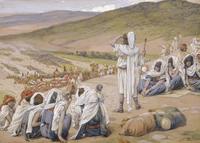
Jacob Sees Esau Coming to Meet Him
James Tissot
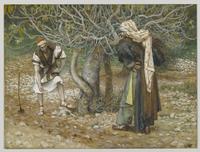
The Vine Dresser and the Fig Tree (Le vigneron et le figuier)
James Tissot
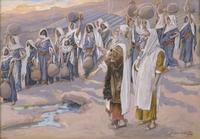
Moses Smiteth the Rock in the Desert
James Tissot
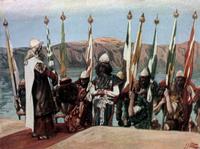
Moses Blesses Joshua Before the High Priest
James Tissot
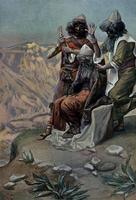
Moses on the Mountain During the Battle, as in Exodus
James Tissot
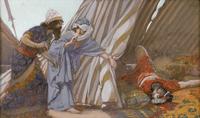
Jael Shows to Barak, Sisera Lying Dead
James Tissot
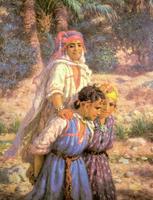
The Alilou Game
Nasreddine Dinet
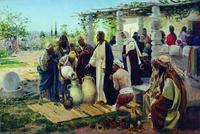
Miracle at Cana
Vladimir Makovsky
Moses Strikes the Rock
James Tissot
Nathan Rebukes David, as in 2 Samuel 120
James Tissot
Jesus Heals the Blind and Lame on the Mountain
James Tissot
The Healing of Ten Lepers (Guérison de dix lépreux)
James Tissot
Amos
James Tissot
Game of little girls in the palm grove or Game of deception or Tzalbiha
Nasreddine Dinet
Crucifixion, seen from the Cross
James Tissot
The Women of Midian Led Captive by the Hebrews
James Tissot
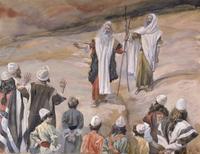
Moses Forbids the People to Follow Him
James Tissot
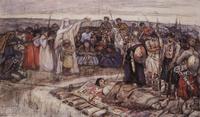
Princess Olga meets the body of Prince Igor
Vasily Surikov