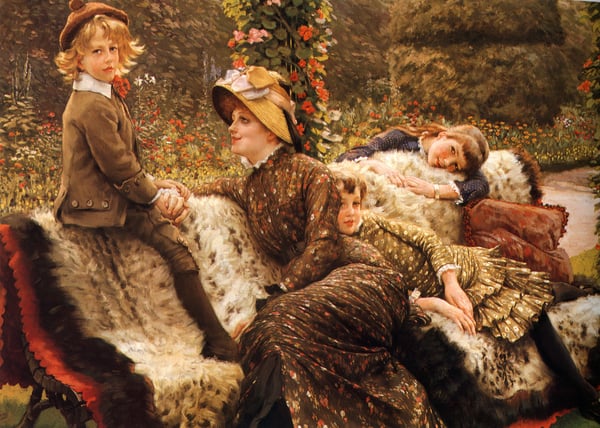
As a realist genre painting, The Garden Bench by James Tissot exemplifies the movement’s commitment to depicting contemporary life with meticulous detail and an unidealized gaze. Within the style of Realism, this work achieves significance by elevating an ordinary, private moment—likely a fashionable social encounter in a Parisian or London garden—into a subject worthy of serious artistic study. Tissot’s treatment of the scene, grounded in the tenets of realism, avoids romanticized sentimentality and instead emphasizes the precise rendering of textures, fabrics, and the nuanced body language of his figures. The painting’s importance lies in how it captures the specific social codes and leisure pursuits of the late 19th-century bourgeoisie, serving as a visual document of its era while also demonstrating the genre painting’s capacity to reflect the complexities of human interaction within a carefully observed, naturalistic setting.