Analisi esperta di The Tailor, Old Testament series di James Tissot
Stile: Realism · Genere: genre painting
Analysis of "The Tailor, Old Testament series" by James Tissot (c. 1896–1902)
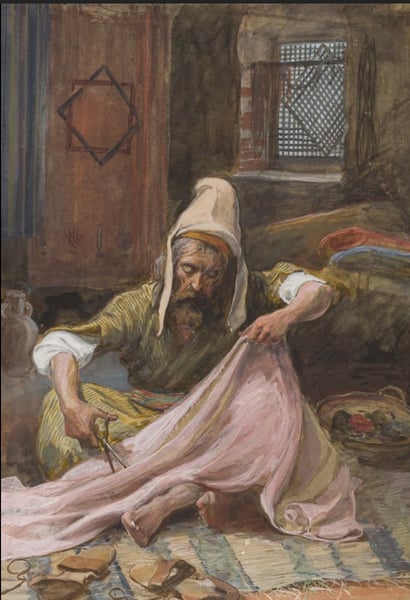
James Tissot’s The Tailor belongs to his ambitious Old Testament series, a late-career project that marked a radical departure from his earlier, society-focused watercolors. Painted during his period of religious revival after a personal crisis, this work exemplifies how Tissot applied the principles of Realism to biblical subject matter—transforming sacred narrative into a genre painting of everyday life.
Significance within Realism and Religious Art
Tissot’s approach was groundbreaking: rather than idealizing biblical figures, he depicted them as ordinary people engaged in mundane tasks. The Tailor shows a craftsman at work, probably making or mending garments—an activity that would have been common in ancient Judea. The artist’s meticulous attention to fabric textures, tools, and the figure’s concentrated expression aligns with Realism’s commitment to observable truth. At the same time, the painting functions as an ethnographic study, reflecting Tissot’s research into the clothing, customs, and material culture of the Holy Land during his travels there in 1886 and 1889.
What Makes It Significant
- Humanizing the Sacred: By presenting a tailor—likely a minor character in an Old Testament story—as a dignified, unidealized laborer, Tissot breaks from the grand, heroic tradition of religious painting. He insists that holiness can be found in the ordinary, a key Realist tenet.
- Documentary Precision: The work is filled with historically researched details: the cut of the tunic, the wooden loom or sewing frame, the earthenware vessel. This accuracy served Tissot’s goal of providing a visual “record” of biblical life, making the series popular as a teaching tool.
- Transition in Tissot’s Career: The Tailor marks the artist’s shift from chronicling Parisian high society to immersing himself in devout, documentary storytelling. It is a bridge between his earlier Impressionistic touches and the later, almost photographic realism of his Bible illustrations.
Context in the Series
The Old Testament series comprises 350 watercolors and gouaches (later published as photogravures). Tissot intended them to be used like a graphic Bible, accessible to all. The Tailor likely illustrates a specific verse—perhaps Exodus 28 (priestly garments) or 2 Kings (tailoring in a royal court)—but Tissot’s choice to foreground a humble artisan over a famous miracle or battle underscores his democratic, Realist vision.
Legacy
While some critics dismissed Tissot’s religious works as overly literal or sentimental, The Tailor is now valued as a sophisticated fusion of genre painting and biblical illustration. It demonstrates that Realism, typically associated with secular modernity, could also revitalize ancient narratives by grounding them in tangible, human experience.
Museum / Gallery
Visivamente simili
20 opere con composizione e palette affini
The Moorish Warrior
William Merritt Chase
The Baqdadi goldsmith
Kamal-ol-Molk
An arab sheik
Leon Bonnat
The Koranic school
Nasreddine Dinet
Coffee House in Cairo
Konstantin Makovsky
Turkish Bashi Bazouk Mercenaries Playing Chess in a Market Place
Jean-Leon Gerome
Street Scene near the El Ghouri Mosque in Cairo (detail)
John Frederick Lewis
The Sale of the Child Slave
Vasily Vereshchagin
Arabs Playing Backgammon
Giulio Rosati
A Game of Draughts
Aloysius O'Kelly
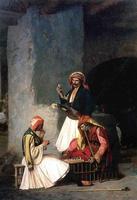
The Draught Players
Jean-Leon Gerome
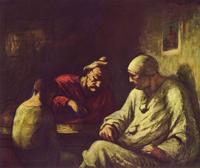
Catch the juggler
Honore Daumier
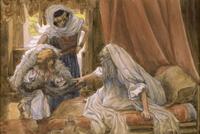
Jacob Deceives Isaac
James Tissot
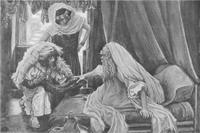
Isaac Feels Jacob as Rebekah
James Tissot
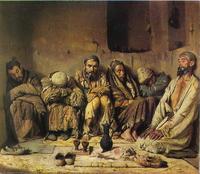
Eaters of opium
Vasily Vereshchagin
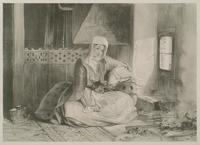
Turkish Female
John Frederick Lewis
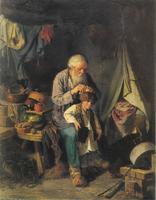
Grandfather and grandson
Vasily Perov
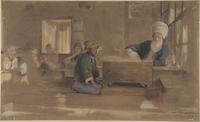
Arab School
John Frederick Lewis
The Slave Market
Jean-François Portaels
Interior of a School in Cairo
John Frederick Lewis