Paul Delvaux sanatçısının Station Forestiere eseri hakkında uzman analizi
Tarz: Surrealism · Tür: cityscape
Expert Analysis: "Station Forestiere" by Paul Delvaux
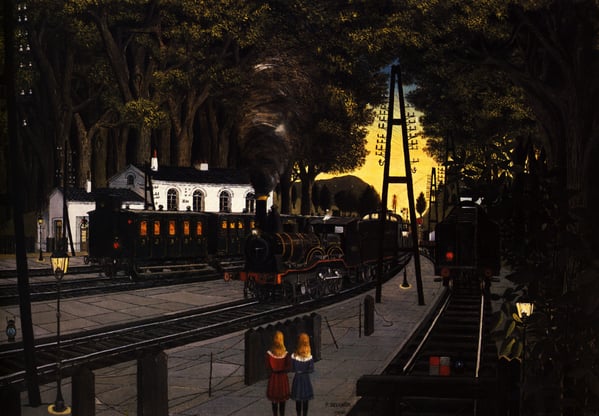
Paul Delvaux’s Station Forestiere (c. 1950s–60s) stands as a quintessential example of Surrealist cityscape, merging the ordinary with the uncanny in a way that defines the artist’s unique contribution to the movement. Working within a meticulous, almost academic realism, Delvaux transforms a seemingly mundane subject—a train station in a forest—into a stage for psychological tension and dreamlike dislocation.
Surrealist Cityscape as Mental Landscape
Unlike the urban dreamscapes of Giorgio de Chirico (which influenced him deeply) or the biomorphic abstractions of Dalí, Delvaux anchors his Surrealism in hyper-specific, architectural environments. In Station Forestiere, the station building—likely a typical Belgian halt—is rendered with crisp, cool precision. Yet it is placed in an incongruous setting: a deep, hushed forest that seems to encroach unnaturally, its trees looming like silent sentinels. This juxtaposition destabilizes the viewer’s sense of place, turning the depot into a threshold between the rational world of travel and an inexplicable, primordial void.
Significance within Delvaux’s Oeuvre
Delvaux’s work is famous for its recurring motifs: solemn, often nude or classically draped women, skeletal figures, and nocturnal train stations. Station Forestiere likely omits the human figure (or includes a single, distant figure), focusing instead on the architecture and the forest as characters. This accomplishes two things:
- The uncanny silence – The empty platform and motionless trees evoke a suspended moment, a waiting that has no resolution. The station, a place of transit and chatter, becomes a mausoleum of stillness.
- The forest as psychological space – The “forestiere” (forest) element is not just a backdrop; it is an active, almost menacing presence. Delvaux often used nature as a counterpart to rigid man-made forms—here, the vertical lines of tree trunks echo the station’s columns, creating a subliminal rhythm that blurs the boundary between the natural and the constructed.
Delvaux’s Technical Mastery and Legacy
What makes Station Forestiere significant is Delvaux’s ability to render the impossible with photographic authority. The handling of light is particularly telling: a soft, lunar glow (typical of his scenes) flattens the perspective and drains the color, lending the scene an oneiric, post-coital calm. This is not the jarring, violent Surrealism of a Max Ernst, but a quiet, unnerving poetry. The work stands as a bridge between Surrealism’s exploration of the subconscious and the older tradition of the pittura metafisica—and it is precisely this fusion that secures Delvaux’s place as a master of the cityscape genre within Surrealism. In Station Forestiere, the viewer is left not with answers, but with the unsettled sensation of having stumbled into a dream that belongs to someone else.
Görsel olarak benzer
İlişkili kompozisyon ve renk paletine sahip 20 eser
Train Going over a Bridge at Night
Eric Ravilious
Express Train Arrives
Hans Baluschek
Level Crossing
L. S. Lowry
Train in Evening
Paul Delvaux
Train in Kakheti
Niko Pirosmani
Big City Train Station
Hans Baluschek
Unidentified Railway Station on Dakar-saint-louis Line
Edouard Riou
La gare de Rouen
Raphael Delorme
Train and Bathers
Edward Hopper
Railway Station in Kayes
Edouard Riou
Murnau view with railway and castle
Wassily Kandinsky
Station in Davos
Ernst Ludwig Kirchner
Death Jumbo
Sue Coe
A Railway Engine
David Cox
The Railroad Station at Argenteuil
Claude Monet
Scheiber Hugó, Vonat 1920
Scheiber Hugó
Railways in the Taunus
Ernst Ludwig Kirchner
IMG 20240113 014005
Robin Fadel
Train on a High Bridge
Marjorie Acker Phillips
For the Brussels Luxembourg Station
Paul Delvaux