Expertenanalyse zu Paul Delvauxs The Man in the Street
Stil: Surrealism · Genre: nude painting (nu)
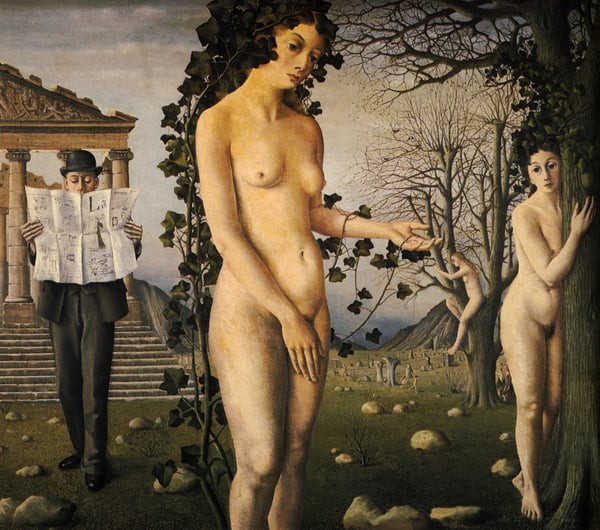
Paul Delvaux’s The Man in the Street (c. 1940) is a quintessential example of his idiosyncratic Surrealist vision, one that merges meticulous academic realism with profoundly disquieting dreamscapes. While the work is classified as a nude painting (nu) — a genre Delvaux revisited obsessively — its significance lies in how it subverts traditional representations of the nude through the lens of Surrealist dislocation and erotic melancholy.
Composition and Surrealist Juxtaposition
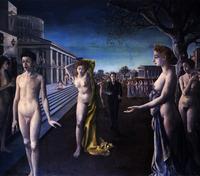
The painting depicts a lone, clothed male figure standing in a deserted, classically styled street or plaza. He is surrounded by one or more nude women, rendered with the cold, sculptural precision of a neoclassical statue. Delvaux’s streets are never neutral; they are stage-like, often borrowed from his memories of Brussels’ suburban train stations or the grandiose public squares of his youth. Here, the everyday setting (a street) collides with the private, intimate realm of the nude, creating a jarring dissociation. The man — stiff, expressionless, almost ghostly — is a passive observer in a world where the female nude is both monument and spectral presence. This inversion of the traditional male gaze (the man is overwhelmed, not the viewer) is central to Delvaux’s surrealist strategy.
Psychological Undertones and the Uncanny
Delvaux’s nudes are never sensual in a conventional sense. They are frozen, hollow-eyed, and often disconnected from each other, evoking a sense of loneliness and repressed desire. The “man in the street” is an Everyman, possibly a self-portrait of the artist’s own emotional detachment. In Delvaux’s universe, the nude is not a celebration of the body but a symbol of unattainable, almost pathological longing — an idea reinforced by the stark, shadowless daylight and the unnatural stillness. The street itself becomes a liminal space: public yet utterly empty, real yet uncanny. This tension between the banal and the dreamlike is what makes Delvaux’s work a unique contribution to Surrealism, distinct from the automatic writing of André Breton or the Freudian objects of Dalí.
Significance Within the Surrealist Movement
While Delvaux is often grouped with the Belgian Surrealists (alongside Magritte), his approach is more indebted to the classical tradition of De Chirico’s metaphysical painting than to psychoanalytic symbolism. The Man in the Street demonstrates his signature method: a controlled, almost architectural composition that belies a deeply irrational logic. The work is significant because it challenges Surrealism’s anti-academic impulses; Delvaux uses hyper-realistic technique not to ground the scene in reality, but to make the impossible feel disturbingly plausible. The nude figure, stripped of agency and emotion, becomes a cipher for the viewer’s own anxieties about desire, time, and the silent emptiness of modern life.
In sum, Delvaux’s painting stands as a masterful integration of the nude genre and Surrealist pathos — a quiet, haunting tableau where the street is a stage for the unresolved drama of the psyche. Its significance lies not in overt shock, but in the chilling precision of its everyday uncanny.
Visuell ähnlich
20 Werke mit ähnlicher Komposition und Farbpalette
Night Visit
Paul Delvaux
Women-Trees
Paul Delvaux
The Renascence of Venus
Walter Crane
The Sleeping Town
Paul Delvaux
Czene Béla, Éva,1940
Czene Béla
Venus with Cupid the Honey Thief
Lucas Cranach the Elder
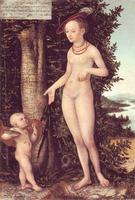
Venus and Cupid
Lucas Cranach the Elder
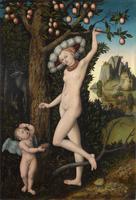
Cupid complaining to Venus.
Lucas Cranach the Elder
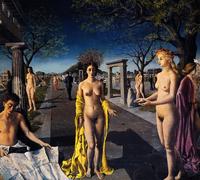
The entrance to the city
Paul Delvaux
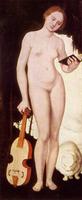
Woman with Cat (Allegory of Music)
Hans Baldung
The Temptation of Adam and Eve
Mariotto Albertinelli
Afternoon Mass
Paul Delvaux
Venus standing in a landscape
Lucas Cranach the Elder
Adam and Eve
Lucas Cranach the Elder
Dawn of the Town
Paul Delvaux
The Concert
Paul Delvaux
Adam and Eve (two panels)
Albrecht Durer
The Three Graces
Lucas Cranach the Elder
Eve (right panel)
Albrecht Durer
Reclining River Nymph at the Fountain
Lucas Cranach the Elder