
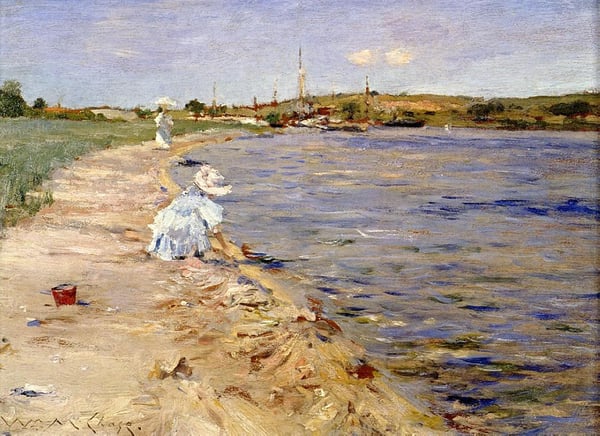
Expert analysis of William Merritt Chase’s Beach Scene - Morning at Canoe Place
Style: Impressionism · Genre: landscape
Expert Analysis: "Beach Scene – Morning at Canoe Place" by William Merritt Chase
William Merritt Chase’s Beach Scene – Morning at Canoe Place stands as a luminous example of American Impressionism, a movement that adapted French Impressionist ideals to distinctly American subjects and light. Painted en plein air, the work captures the fleeting, pearlescent quality of an early morning along the shore, likely at Shinnecock Hills on Long Island, where Chase established his famous summer school.
Significance within Impressionism and Period
Chase’s handling of light and atmosphere is the painting’s defining achievement. The title explicitly anchors the scene in a specific time—morning—and Chase uses a high-key, pastel-infused palette of soft blues, lavenders, pinks, and creamy whites to convey the cool, hazy glow of dawn. The brushwork is characteristically Impressionistic: broken, rapid strokes that dissolve form into shimmering patches of color. The sand, water, and sky are not flat areas but mosaic-like fields of hue, suggesting the optical mixing that defines the movement.
Yet Chase’s Impressionism is distinctly American. Unlike the more urban or industrialized scenes of his French counterparts, Beach Scene celebrates a genteel, leisured landscape—an idyllic coastal retreat popular among the emerging middle class. The composition, with its high horizon line and foreground dominated by the sand and figures, draws the viewer into the scene’s intimacy. Small groups of women and children are rendered with swift dabs of paint, suggesting movement and social activity without sacrificing the sense of serene, measured pleasure.
Moreover, this work exemplifies Chase’s mastery of plein air practice. He often painted multiple versions of the same location at different times of day to study shifting light, and Morning at Canoe Place likely belongs to such a series. The painting’s significance also lies in its pedagogical influence: Chase’s Shinnecock school taught generations of American artists to observe nature directly, making this beach scene not just a beautiful object but a document of a key teaching philosophy.
In sum, Beach Scene – Morning at Canoe Place is significant for its refined translation of Impressionist optical theory into an American coastal vernacular, its demonstration of Chase’s deft atmospheric control, and its role in shaping the direction of American landscape painting at the turn of the century.
Museum / Gallery
Visually similar
20 works with related composition and palette
Walberswick. Children Paddling
Philip Wilson Steer
Bank at Poissy
Francis Picabia
Treading Clams, Wickford
William James Glackens
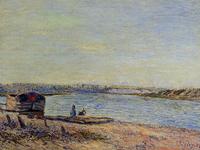
The Hills of Veneux, Seen from Saint Mammes
Alfred Sisley
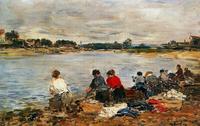
Laundresses on the Banks of the Touques
Eugene Boudin
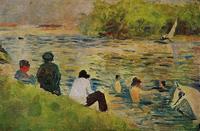
The Bank of the Seine
Georges Seurat
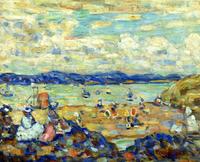
St. Malo
Maurice Prendergast
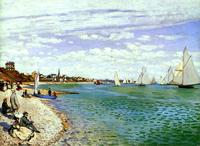
Regatta at Sainte-Adresse
Claude Monet
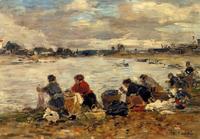
Laundresses on the Banks of the Touques
Eugene Boudin
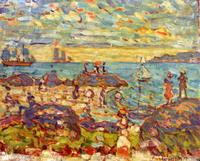
The Point, Gloucester
Maurice Prendergast
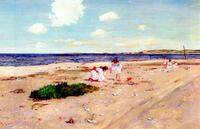
Shell Beach at Shinnecock
William Merritt Chase
The Coastline at Plougastel
Eugene Boudin
Harbor, Afternoon
Maurice Prendergast
Bougival
Alfred Sisley
St. Malo
Maurice Prendergast
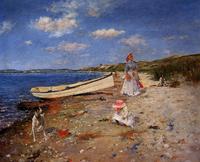
A Sunny Day at Shinnecock Bay
William Merritt Chase
Banks of the Seine
Alfred Sisley
The fishing fleet of Veere
Jan Toorop
On the Cliff at Portrieux
Berthe Morisot
Walnut Tree in a Thomery Field
Alfred Sisley