
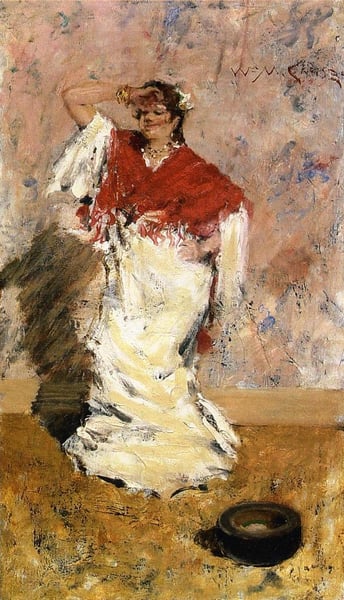
Analisi esperta di Dancing Girl di William Merritt Chase
Stile: Impressionism · Genere: genre painting
Analysis of "Dancing Girl" by William Merritt Chase
William Merritt Chase’s Dancing Girl is a quintessential example of American Impressionism, a movement that adapted the radical optical and color theories of French Impressionism to distinctly American subjects. Although the structured facts classify this work under the genre of “genre painting”—depicting everyday life—Chase elevates a seemingly casual moment into a study of light, movement, and character.
Context and Style
Chase was a leading figure in American art education and a master of the plein air (outdoor) technique. In Dancing Girl, he captures a fleeting gesture with the loose brushwork and luminous palette that define Impressionism. Rather than focusing on narrative or moralizing content, Chase prioritizes the sensory experience: the shimmer of fabric, the play of shadows, and the momentary grace of the dancer’s pose. This aligns with the Impressionist goal of conveying the transient effects of light and atmosphere.
Significance within Impressionism
The painting’s significance lies in how Chase synthesizes French Impressionist methods with a uniquely American sensibility. While French Impressionists often painted urban leisure or rural landscapes, Chase turned his attention to the intimate, unposed moments of domestic or informal performance. The figure of the dancer is not a classical ballerina but a contemporary girl, caught mid-step—perhaps in a private rehearsal or casual play. This choice reflects the democratic spirit of genre painting and the Impressionist interest in the “slice of life.”
Technical Hallmarks
Chase employs visible, energetic brushstrokes to suggest motion and texture—note the dabs of white and pastel tones that define the dancer’s skirt and the soft focus of the background. The light seems to emanate from an unseen source, illuminating the figure’s face and hands with a warm, natural glow. The composition is cropped asymmetrically, a device borrowed from photography and Japanese prints, which enhances the sense of spontaneity.
Legacy
Dancing Girl demonstrates Chase’s ability to balance academic draftsmanship with the freedom of Impressionist color. It remains significant as a bridge between European avant-garde techniques and the emerging identity of American art in the late 19th century, celebrating everyday beauty with painterly verve.
Museum / Gallery
Visivamente simili
20 opere con composizione e palette affini

Portrait of Jeanne in a Pink Robe
Camille Pissarro

Woman with tray
Francesco Didioni

Korean Woman
Fujishima Takeji
Interior with Artist's Sister, Emma Weie
Edvard Weie

A Parisian Beggar Girl
John Singer Sargent
The Japanese Lady
Henri Matisse
Carmencita (Wife of the Artist)
Lovis Corinth

The Mannequins Ippy and Gertie at Hirsch, Amsterdam
Isaac Israels

Girl in Profile
Gwen John
Harmony in Coral and Blue: Milly Finch
James McNeill Whistler
Hungarian Shawl
Agnes Goodsir
Portrait of a Woman
Konstantin Korovin
Dame in avondtoilet
Isaac Israels
Woman with a Corset
Matej Sternen
Margitka
Bertalan Por

Rosina
John Singer Sargent
Czóbel Béla Lány Fehér Bluzban
Bela Czobel
Gypsy Woman (Study)
Nicolae Vermont
Portrait of Z. Pertseva
Konstantin Korovin
Study of a Woman in a Petticoat
Edouard Vuillard