Analyse experte de Haystacks de Willard Metcalf
Style : Impressionism · Genre : landscape
Expert Analysis of Willard Metcalf’s Haystacks
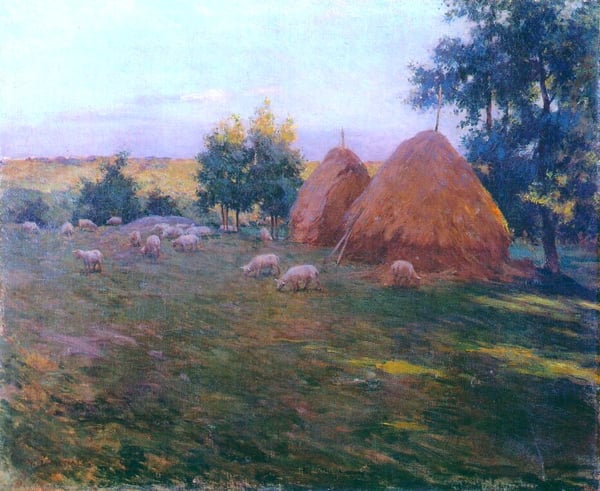
Willard Metcalf’s Haystacks stands as a quintessential example of American Impressionism, a movement that adapted the French Impressionist focus on light and atmospheric effects to distinctly American subjects. Painted during a period when Metcalf was deeply engaged with the landscape of New England, this work captures the pastoral rhythms of rural life through a prism of shimmering color and broken brushwork.
Significance within Impressionism
Like Monet’s celebrated Haystacks series, Metcalf’s painting transforms a humble agricultural subject into a vehicle for exploring changing light and season. However, Metcalf’s treatment is more restrained and structurally grounded, reflecting the American Impressionist tendency to balance European optical experiments with a sense of solid form and native terrain. The haystacks themselves are rendered not as mere piles of grass but as sculptural masses that anchor the composition, their rounded silhouettes echoing the rolling hills of the landscape.
Color and Atmosphere
Metcalf employs a warm, golden palette—ochres, soft yellows, and muted greens—to evoke the late summer or early autumn light. Dappled shadows in violet and blue suggest the fleeting quality of sunlight, while the short, visible brushstrokes characteristic of Impressionism create a vibrant, almost tactile surface. The sky, often a key element in Metcalf’s work, is treated with feathery touches of white and cerulean, reinforcing the sense of open air and temporal specificity.
Cultural and Artistic Context
As a member of the Ten American Painters—a group that broke from conservative academic traditions—Metcalf championed plein-air painting and everyday subject matter. Haystacks exemplifies this commitment: it elevates an ordinary farm scene into a meditation on the sublime beauty of the American countryside. Unlike Monet’s series, which often emphasizes the haystacks as isolated forms, Metcalf integrates them into a broader landscape, emphasizing harmony between human labor and nature.
In summary, Haystacks is significant for its synthesis of Impressionist technique with a distinctly American sense of place, demonstrating how Metcalf and his peers refined European innovations to create a national art rooted in the quiet grandeur of the ordinary.
Visuellement similaire
20 œuvres à la composition et à la palette proches
Evening
Joseph Farquharson
July Afternoon
Guy Rose
The Harvest at Montfoucault 2
Camille Pissarro
Stacks of Wheat (End of Summer)
Claude Monet
Haystacks, midday
Claude Monet
Stacks of Wheat (End of Day, Autumn)
Claude Monet
Haystacks, Last Sunrays
Claude Monet
Haystacks
Theodor Pallady
Haystacks, Giverny
Lilla Cabot Perry
The Harvest at Montfoucault
Camille Pissarro
Outskirts of the Village
Victor Puzyrkov
Plateau Bromont at Pontgibaud (Puy de Dôme)
Armand Guillaumin
Haystacks
Léon Augustin Lhermitte
The haystack, Pontoise
Camille Pissarro
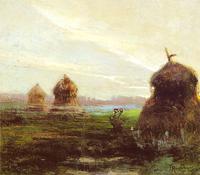
Pejzaz ze stogami
Ferdynand Ruszczyc
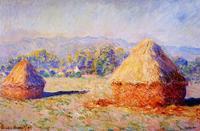
Grainstacks in the Sunlight, Morning Effect
Claude Monet
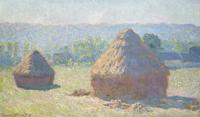
Haystacks, end of Summer
Claude Monet
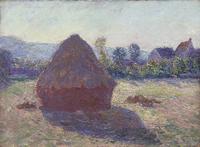
A Haystack in the Evening Sun
Claude Monet
Haymaking
Isaac Levitan
Grainstacks at Giverny, Sunset
Claude Monet