Analisi esperta di The battle of Issus(fragment) di Albrecht Altdorfer
Stile: Northern Renaissance · Genere: battle painting
Analysis of "The Battle of Issus (fragment)" by Albrecht Altdorfer
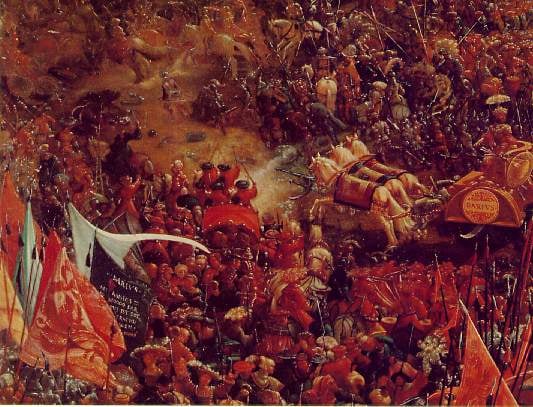
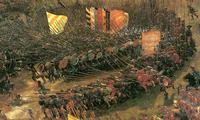
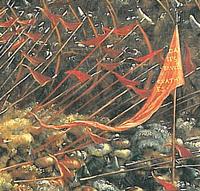
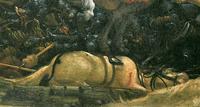
Albrecht Altdorfer’s The Battle of Issus (c. 1529) is one of the most audacious achievements of the Northern Renaissance—a battle painting that transcends mere historical record to become a cosmic vision of human conflict. This fragment, though incomplete, retains the essential qualities that make the full work (housed at the Alte Pinakothek, Munich) a landmark in Western art.
Significance within the Northern Renaissance and Battle Genre:
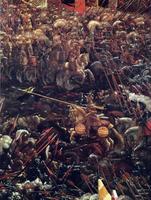
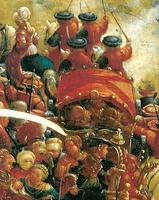
Altdorfer, a leading figure of the Danube School, broke with the static, symbolic battle scenes of the late Middle Ages. Here he offers a bird’s-eye panorama that swallows the combatants into an immense, swirling landscape. The detail of the fragment—likely showing a dense cluster of cavalry and infantry—demonstrates his meticulous observation of armor, weaponry, and chaotic motion, hallmarks of Northern Renaissance precision. Yet he pairs this naturalism with an almost transcendental sweep: the tiny figures become a mere thread in a cosmic tapestry.
Key innovations visible in the fragment:
- Atmospheric perspective and light: Altdorfer was a pioneer in rendering atmospheric effects. Even in this portion, the fractured play of light across the soldiers and the distant hills hints at his use of glowing, golden tones to suggest divine or historical magnitude.
- Microscopic detail within a macrocosm: Each figure is individually rendered (note the distinct helmets, lances, and horse trappings), yet collectively they dissolve into a teeming organism. This duality—intimate precision and epic scale—defines the work’s power.
- Landscape as protagonist: The fragment’s terrain—rocky outcroppings, winding rivers, and towering clouds—is not mere backdrop. Altdorfer elevates the landscape to a co-equal player, foreshadowing the Romantic sublime. The battle becomes an eternal drama between order (the disciplined phalanx) and nature’s indifferent grandeur.
Artistic and historical context:
Painted for Duke William IV of Bavaria, The Battle of Issus depicts Alexander the Great’s victory over Darius III in 333 BCE. But Altdorfer transposes it into a timeless allegory. The fragment, with its intense color and dynamic diagonal thrusts, reveals his debt to both Dürer’s spatial mastery and the visionary tradition of Grünewald. It is a work where history and landscape merge: the clashing armies are dwarfed by the crescent moon, the storm clouds, and the distant Alpine peaks, suggesting that all human ambition unfolds under an eternal, watchful sky.
Enduring significance:
This fragment encapsulates why Altdorfer’s painting is often called the first “modern” battle scene: it refuses to glorify individual heroism, instead immersing the viewer in a sublime, almost terrifying overview of war. For the Northern Renaissance, it marks a shift from the didactic to the overwhelming—a meditation on power, nature, and the fragile scale of human endeavor. Even in its broken state, the fragment retains that breathtaking ambition.
Visivamente simili
20 opere con composizione e palette affini
The battle of Issus(fragment)
Albrecht Altdorfer
The battle of Issus (fragment)
Albrecht Altdorfer
The battle of Issus(fragment)
Albrecht Altdorfer
The battle of Issus (fragment)
Albrecht Altdorfer
The battle of Issus(fragment)
Albrecht Altdorfer
Sobieski Sending Message of Victory to the Pope
Jan Matejko
The battle of Issus(fragment)
Albrecht Altdorfer
Batalha do Avaí
Pedro Américo
Sobieski II
Jan Matejko
Battle of Grunwald
Jan Matejko
Congress of the Kings
Jan Matejko
Conquest of Zara
Tintoretto
The Battle of Nazareth
Antoine-Jean Gros
Varna
Jan Matejko
The battle of Issus(fragment)
Albrecht Altdorfer
The Battle of Tetouan (detail)
Marià Fortuny
Prince Eugene of Savoy at the Battle of Zenta
Anton Romako
Sobieski at Vienna
Jan Matejko
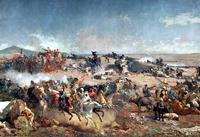
The Battle of Tetouan (detail)
Marià Fortuny
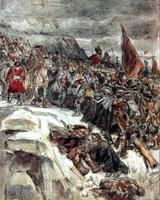
Russian Troops under Suvorov Crossing the Alps (study)
Vasily Surikov