Analisi esperta di The battle of Issus(fragment) di Albrecht Altdorfer
Stile: Northern Renaissance · Genere: battle painting
Expert Analysis of The Battle of Issus (Fragment) by Albrecht Altdorfer
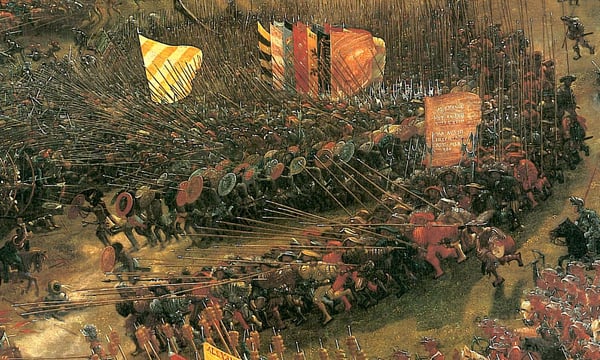
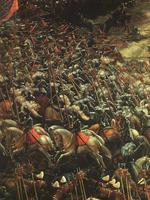
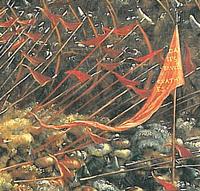
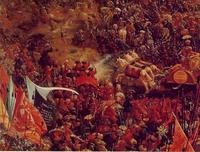
As a seminal work of the Northern Renaissance, Albrecht Altdorfer’s The Battle of Issus—even in its fragmentary state—stands as a revolutionary fusion of history painting and landscape art. Created around 1529, the full panel (of which this is a surviving portion) depicts Alexander the Great’s victory over the Persian king Darius III in 333 BCE. However, what elevates this work beyond a mere battle record is Altdorfer’s extraordinary transformation of the scene into a cosmic spectacle.
Significance within the Northern Renaissance
The Northern Renaissance is characterized by a meticulous attention to detail, naturalistic observation, and a burgeoning interest in landscape as an expressive element. Altdorfer pushes these conventions to an unprecedented extreme. In this fragment, we see his signature “world landscape” approach: a bird’s-eye view that compresses an entire region—mountains, rivers, cities, and an endless sea—into a single, swirling vista. The battle itself is a chaotic tapestry of tiny figures, lances, and banners, yet it is dwarfed by the overwhelming scale of nature and the heavens.
What Makes This Work Exceptional
-
Cosmic Perspective and Drama: Altdorfer here anticipates the Baroque sublime. The fragment likely shows the climactic clash of armies, but the true drama is in the sky—a blazing sunset (or sunrise) that casts a golden and blood-red glow over the arena. This is not a passive backdrop; the light itself seems to participate in the battle, as if nature mirrors the struggle of empires. For its time, this manipulation of light to convey emotional and historical weight was radical.
-
Landscape as History: Before Altdorfer, battle paintings typically centered on close combat or leaders. By contrast, The Battle of Issus subordinates individual heroism to the vastness of geography and time. The fragment reveals how Altdorfer used the landscape to create a panoramic narrative: the armies are dispersed across a terrain that could be any European or Near Eastern region, blurring the line between specific history and universal conflict.
-
Technical Mastery of Detail: Typical of the Northern Renaissance, Altdorfer renders every soldier, tent, and mountain with miniature precision. This fragment would have been part of a larger panel where the viewer can zoom in on countless micro-narratives—fleeing horsemen, fallen standards, the glint of armor. Yet this detail never overwhelms the overall composition, as the swirling lines of the landscape and martial formations guide the eye in a rhythmic flow.
-
Influence on Later Art: This work directly inspired later painters like Peter Paul Rubens and even influenced the development of panoramic battle scenes in the Baroque and Romantic periods. Altdorfer’s ability to condense a world of action into a single, optically dizzying frame marks a high point of the Danube School and Northern Mannerism.
Conclusion
Even as a fragment, The Battle of Issus encapsulates Altdorfer’s genius: the marriage of micro-level Northern precision with macro-level cosmic vision. It is significant not merely as a record of an ancient battle, but as a meditation on the insignificance of human conflict against the eternal backdrop of nature and time—a theme centuries ahead of its era. This fragment serves as a window into one of the most ambitious and influential history paintings of the Renaissance.
Visivamente simili
20 opere con composizione e palette affini
The battle of Issus(fragment)
Albrecht Altdorfer
The battle of Issus (fragment)
Albrecht Altdorfer
The battle of Issus (fragment)
Albrecht Altdorfer
Gustaf II Adolf before Battle of Lützen
Nils Forsberg
The battle of Issus(fragment)
Albrecht Altdorfer
The battle of Issus(fragment)
Albrecht Altdorfer
La bannière de Strasbourg à la bataille de Nancy
Léo Schnug
Sobieski II
Jan Matejko
Battle of Grunwald
Jan Matejko
The Battle of Dorylaeum
Gustave Dore
The Charge of the 21st Lancers at Omdurman
Richard Caton Woodville Jr.
Oleg meets wizard
Viktor Vasnetsov
The Battle of Arsuf
Gustave Dore
Expedición De Almagro
Pedro Subercaseaux
Battle of Lekkerbeetje, Vughterheide (Netherlands)
Esaias van de Velde
Sobieski at Vienna
Jan Matejko
The Battle of Nicaea in 1097
Gustave Dore
Battle of Kerzhenets
Nicholas Roerich
Charge Du 21ème Lancier À La Bataille D'omdurman (détail)
Richard Caton Woodville Jr.
Siege of Pskov by Polish King Stefan Batory in 1581
Karl Bryullov