
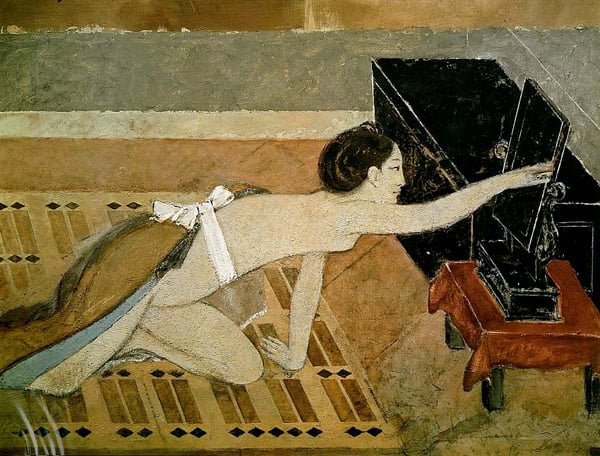
Expertenanalyse zu Balthuss Japanese Girl with a Black Mirror
Stil: Expressionism, Japonism · Genre: genre painting
Expert Analysis of "Japanese Girl with a Black Mirror" by Balthus
Significance within Expressionism and Japonism
Balthus’s Japanese Girl with a Black Mirror stands as a masterful fusion of two seemingly disparate stylistic currents—Expressionism and Japonism—while remaining firmly rooted in the tradition of genre painting. The work’s significance lies in how Balthus uses the intimate, domestic setting (a girl with a mirror) to explore psychological tension, cultural borrowing, and the collision of interiority with exoticism.
Expressionist Undercurrents
Though Balthus is often linked to magical realism, his treatment of color, space, and the figure here betrays an Expressionist intensity. The “black mirror” is not merely a prop; its dark, reflective surface absorbs rather than reflects light, creating a visual and emotional void that contrasts with the girl’s pale skin and the subdued tonalities of her kimono. This deliberate flattening and muted palette heighten the sense of isolation and introspection—a hallmark of Expressionist portraiture. The girl’s pose, slightly averted gaze, and the mirror’s unnatural darkness suggest a psychological interiority that resists easy interpretation, inviting viewers into a space of ambiguity and unease.
Japonism as Structural Device
The Japonism here is not superficial decoration. Balthus adapts the compositional principles of ukiyo-e prints—asymmetric framing, bold negative space, and a tilted perspective that pushes the figure toward the picture plane. The kimono, the girl’s hairstyle, and the mirror’s rectangular shape echo Japanese lacquerware aesthetics. Yet Balthus transforms these borrowed elements into something distinctly Western in its psychological weight. The figure is not merely an exotic subject; she becomes a mediator between Eastern formality and Western Expressionist angst.
Genre Painting Reimagined
As genre painting, the work portrays a seemingly ordinary moment (a girl with a mirror). But Balthus subverts the genre’s typical narratives of vanity or domesticity. The mirror—traditionally a symbol of self-knowledge or vanity—here offers no reflection. This deliberate absence suggests that identity is obscured, that the self is a darkened space. The “Japanese” title further complicates the reading: is this a Western fantasy of Eastern mystique, or a genuine homage? Balthus leaves the question unresolved, making the painting a commentary on cultural projection as much as a portrait.
Why It Matters
Japanese Girl with a Black Mirror is significant as a rare meeting point of Expressionism’s emotional depth and Japonism’s formal discipline. It challenges the viewer to look beyond surface exoticism and confront the complexity of looking itself—into a mirror that refuses to show us ourselves. In doing so, Balthus elevates a quiet genre scene into a meditation on perception, otherness, and the unseen self.
Visuell ähnlich
20 Werke mit ähnlicher Komposition und Farbpalette
Japanese Girl with Red Table
Balthus
The Adonis plant
Katsushika Hokusai
Reclining Youth
Lo Scheggia
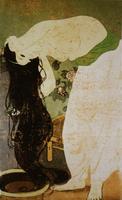
Hair Washing
Tran Van Can

Venus
Mikhail Larionov
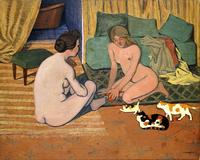
Naked Women with Cats
Felix Vallotton
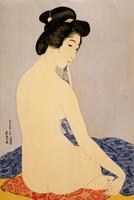
Woman After Bath
Goyo Hashiguchi
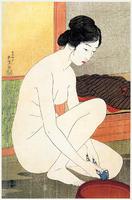
Woman After Bath
Goyo Hashiguchi
The songs of Bilitis
George Barbier
Woman and Kitten
Shotei Takahashi
Untitled
Qiu Ying
Models Hugs
Katsushika Hokusai
Reclining nude
Amedeo Modigliani
The Dawn of of the Dream, or Les Fleurs du Mal
Charles Maurin
Russian Venus
Mikhail Larionov

Sleeping Nude
Balthus

Lying nude
Amedeo Modigliani
Czene Béla, Akt, ,,
Czene Béla
Fragrance of the Hot Spring
Torii Kotondo
The Turkish Room
Balthus