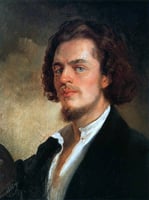
Expert analysis of Konstantin Makovsky’s Widow
Style: Romanticism · Genre: genre painting
Artwork Analysis: "Widow" by Konstantin Makovsky
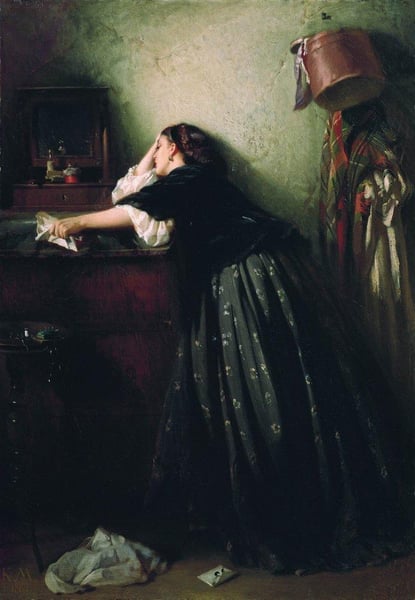
As a genre painting rooted in Romanticism, Konstantin Makovsky’s “Widow” achieves significance through its intimate fusion of emotional intensity and social observation—hallmarks of the Romantic spirit. The work transcends mere depiction of a solitary figure in mourning; it becomes a profound meditation on loss, resilience, and the human condition within the specific cultural framework of 19th‑century Russia.
Emotional Depth and Romantic Sensibility
Romanticism prized the expression of powerful, often somber emotions, and Makovsky delivers this through the widow’s posture, facial expression, and the subtle play of light. The darkened interior, typical of Romantic chiaroscuro, isolates the grieving woman—a visual metaphor for isolation in sorrow. Her downward gaze and clasped hands speak to grief, but also to dignity, avoiding melodrama in favor of restrained, believable pathos. This psychological depth aligns with Romanticism’s fascination with the inner life and the sublime nature of human feeling.
Social and Historical Context
Makovsky was a leading member of the Peredvizhniki (The Wanderers), a group that broke from academic conventions to depict real Russian life. Although “Widow” is not explicitly a social protest, it reflects the Wanderers’ commitment to portraying the hardships of ordinary people. The widow’s modest dress and sparse surroundings hint at economic vulnerability, making the painting a quiet commentary on the precarious state of women who lost their breadwinners in a patriarchal society. This fusion of personal tragedy with broader social realities elevates the artwork beyond simple genre painting into a document of Russian life.
Stylistic Achievement
Makovsky’s masterful handling of textures—the soft fabric of the widow’s shawl, the worn wood of the furniture—anchors the emotional content in a tangible world. The muted palette of browns, grays, and deep blacks reinforces the somber mood, while a faint, warm light from an unseen window introduces a note of hope (or perhaps memory). This control of atmosphere and detail demonstrates Romanticism’s shift toward realism, yet retains the movement’s core focus on subjective experience.
Significance within the Period
“Widow” stands out because it captures a universal archetype—grief—with such specificity that it becomes both timeless and historically grounded. It exemplifies how Romantic genre painting could move beyond anecdote to achieve genuine empathy. Makovsky’s work here is significant for its ability to make the viewer feel the weight of a single, silent moment, proving that Romanticism’s legacy lies not only in grandiose landscapes or heroic history, but in the quiet, resonant stories of ordinary individuals.
Visually similar
20 works with related composition and palette
Female figure
Domenico Induno
Red jacket
Gerolamo Induno
Untitled
Domenico Induno
The Love Letter
Alfred Stevens
The Lady in Blue
Camille Corot
The Love Letter
Jean-Honore Fragonard
The jealous wife
Giacomo Favretto
A naughty naid
Ludwig Knaus
The Governess
Jean-Baptiste-Simeon Chardin
The Modiste
Francois Boucher
Girl at the Lottery
Peter Fendi
A Theatre Dressing Room
Laura Knight
Sertine School
Domenico Induno
The Broken Mirror
Jean-Baptiste Greuze
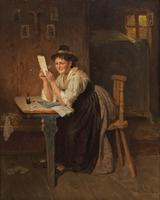
The successful letter
Adolf Eberle
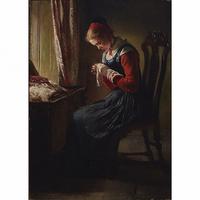
Mending time
Elisabeth Jerichau-Baumann
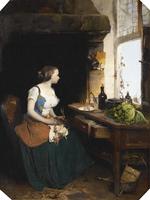
Female figure
Gerolamo Induno
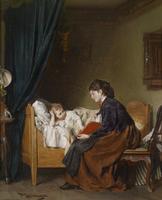
The bedtime story / evening reading hour
Felix Schlesinger
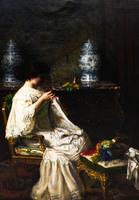
Seamstress in Interior
Paul Edouard Deligny
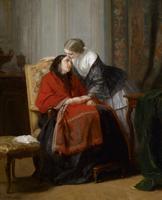
The kiss
Jules Trayer