
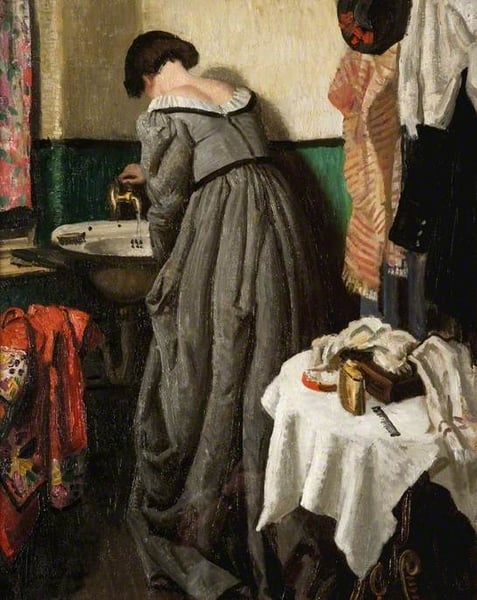
Análisis experto de A Theatre Dressing Room de Laura Knight
Estilo: Impressionism · Género: genre painting
Expert Analysis: "A Theatre Dressing Room" by Laura Knight
Laura Knight (1877–1970) was a groundbreaking British painter who thrived within the Impressionist tradition while forging a distinctive voice in genre painting. A Theatre Dressing Room exemplifies her lifelong fascination with the hidden, unglamorous moments behind the proscenium arch—a subject she made uniquely her own.
What makes the work significant within its style and period:
-
Impressionist treatment of artificial light and confined space.
Knight captures the volatile, dual-source illumination of the dressing room: the warm glow of gas or electric bulbs on the makeup table colliding with the cooler, diffuse backstage light. Her loose, rapid brushwork—hallmarks of Impressionism—conveys the shimmer of silk, the powdering of faces, and the restless energy of performers preparing. The mirror reflects not just the sitter but the painter’s own presence, a nod to the Impressionist interest in fleeting, subjective perception. -
Expansion of genre painting into the backstage world.
Genre painting traditionally depicted domestic or street life, but Knight boldly ventured into the theatre’s private zones. Here, the “everyday” is the extraordinary pre-show ritual—a private moment of transformation. This aligns with the Impressionist desire to capture contemporary life, yet Knight’s choice of dressing room interiors was radical for its time, granting viewers access to a space normally hidden from the public. -
Feminist and professional significance.
Knight was one of the few female artists to gain prominence in the male-dominated art world of early 20th-century Britain. Her theatre scenes were not merely decorative; they asserted a woman’s right to observe and depict professional female bodies—dancers, actresses, and circus performers—with empathy and unidealized truth. A Theatre Dressing Room celebrates the labor behind glamour, making visible the artistry of both the performer and the painter. -
Technical mastery in a challenging environment.
The composition is a tour de force of perspective: the mirror multiplies space, the clutter of costumes and props creates a rhythmic disorder, and the figure’s pose suggests both fatigue and focus. Knight’s Impressionist palette—pinks, golds, deep blues, and harsh whites—evokes the sensory overload of backstage: the smell of greasepaint, the rustle of fabric, the murmur of voices.
In sum, A Theatre Dressing Room is significant as an Impressionist genre scene that redefines the boundaries of both movements. It showcases Knight’s unique eye for the interplay of light and theatrical artifice, her feminist commitment to portraying working women, and her ability to transform a mundane preparation into a luminous, psychological study of identity and performance.
Género
Estilo
Visualmente similares
20 obras con composición y paleta relacionadas
Female figure
Domenico Induno
Widow
Konstantin Makovsky
Red jacket
Gerolamo Induno
Girl at the Lottery
Peter Fendi
Borch Woman Sewing
Gerard Terborch
In the artist's studio
Luigi Da Rios
The jealous wife
Giacomo Favretto
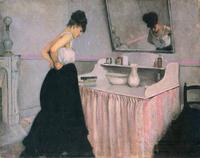
Woman at a Dressing Table
Gustave Caillebotte
The successful letter
Adolf Eberle

A mother feeding her little daughter with a bunch of cherries in a farmhouse kitchen
Alfred Downing Fripp

Woman Washing Hands
Gerard Terborch
A scene of two ladies in an interior
Harry Brooker
Untitled
Domenico Induno
The bedtime story / evening reading hour
Felix Schlesinger
The new dress
Felix Schlesinger
Loved and lost
Haynes King
Untitled (woman sewing)
Meyer von Bremen
Breton seamstresses working in a sewing workshop
Jules Trayer
Young Woman in the Atelier
Janos Tornyai
An interrupted game
Luigi Da Rios