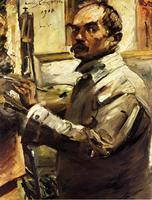
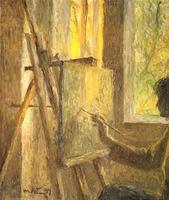
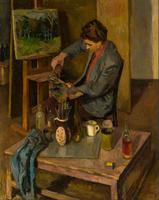
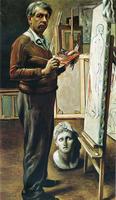
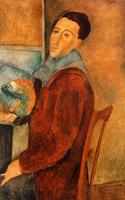
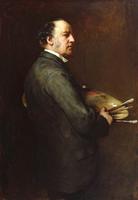
Expert Analysis: "Self Portrait with Palette" by Theo van Rysselberghe
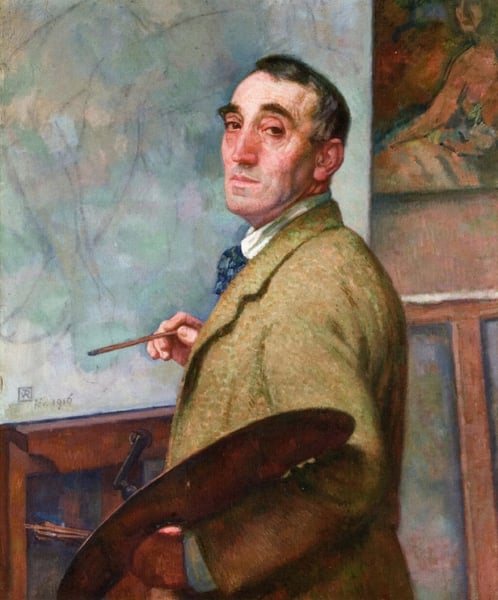
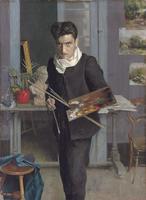
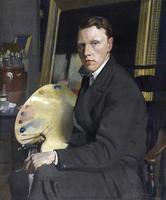
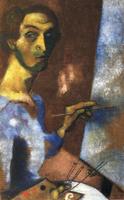
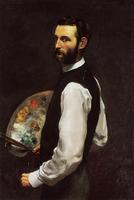
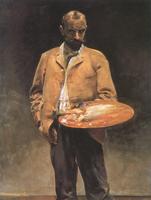
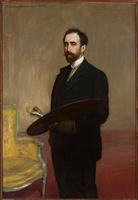
As a Post-Impressionist self-portrait, this work is significant for its synthesis of the movement’s core concerns: the artist’s subjective identity, the expressive use of color and light, and a departure from strict naturalism toward a more personal visual language. Van Rysselberghe, a leading figure in Belgian Neo-Impressionism, here adapts the systematic pointillist technique—typically applied to landscapes and portraits of others—to the introspective genre of self-portraiture. The inclusion of the palette not only identifies the sitter as an artist but also serves as a meta-commentary on the act of seeing and creating. By portraying himself with the tools of his trade, van Rysselberghe asserts the primacy of the maker’s perception, a hallmark of Post-Impressionist individualism. The deliberate, methodical application of color (characteristic of his Divisionist approach) becomes a vehicle for psychological depth, transforming the self-portrait from mere likeness into a study of the artist’s consciousness. This work thus exemplifies how Post-Impressionists moved beyond Impressionism’s fleeting optical effects to imbue their paintings with symbolic, emotional, and reflexive meaning.