Expert analysis of Theo van Rysselberghe’s Spaarnwoude island
Style: Impressionism, Realism · Genre: landscape
Expert Analysis: "Spaarnwoude Island" by Theo van Rysselberghe
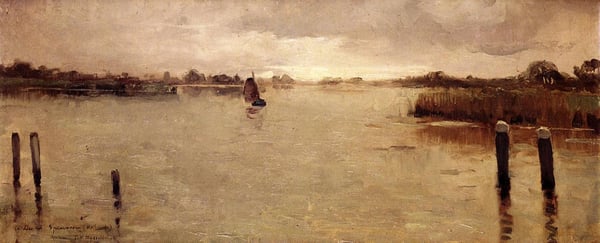
Theo van Rysselberghe’s Spaarnwoude Island stands as a compelling synthesis of two pivotal 19th-century movements—Impressionism and Realism—within the landscape genre. Though van Rysselberghe is most celebrated for his later Pointillist works, this painting reflects his earlier mastery of capturing atmospheric effects while maintaining a truthful, unidealized depiction of the natural world.
Significance within Impressionism: The work exemplifies the Impressionist preoccupation with light and transient moments. Van Rysselberghe applies broken brushwork and a luminous palette to render the reflective quality of water and the soft, shifting sky over the island. The scene is suffused with a palpable sense of air and moisture, typical of plein-air practice. Yet unlike pure Impressionists who often dissolved form in favor of optical sensation, van Rysselberghe retains a structured composition—bridging Impressionist color theory with a disciplined realism.
Significance within Realism: While the brushwork is lively, the artist does not abandon the solidity of forms. The island’s trees, the bank, and the distant horizon are rendered with careful observation of local topography and natural detail. This Realist foundation prevents the landscape from becoming a mere exercise in light; it remains a specific, recognizable place—Spaarnwoude, a scenic area near Haarlem in the Netherlands. The painter’s commitment to truth-to-nature anchors the fleeting Impressionist effects in a tangible, earthbound reality.
Art-Historical Context: As a leading figure of the Belgian avant-garde, van Rysselberghe was instrumental in introducing French Impressionism to his home country. Spaarnwoude Island occupies a transitional moment in his career, where he synthesized these influences before adopting the systematic divisionism of Neo-Impressionism. This work thus demonstrates how van Rysselberghe used the freedom of Impressionist technique without sacrificing the descriptive clarity prized by the Realist tradition—a balance that would define his early period and set the stage for his later innovations.
Visually similar
20 works with related composition and palette
Sunset in Brière
Ferdinand du Puigaudeau
Seascape
Louis Artan
Marsklandskap
Carl Fredrik Hill
At Fordwich, Kent
Frederick George Cotman
The Fisherman
Constant Troyon
The Marsh in the Souterraine
Theodore Rousseau
Fishing on the Tisza
Laszlo Mednyanszky
A June Morning
Robert Julian Onderdonk
Delaware River Scene
Thomas Eakins
Scene along a Dutch River
John Henry Twachtman
Moonlight, Flanders
John Henry Twachtman
Coucher de soleil sur l'étang
Pierre Emmanuel Damoye
Rowing on the river
Johan Hendrik Weissenbruch
The Toques at Saint-Arnoult
Eugene Boudin
At the Amstel Sun
Piet Mondrian
Dutch Canal Scene
James Campbell Noble
Etang (also known as The Pond)
John Henry Twachtman
A Peasant in a Moored Barge
Cornelis Vreedenburgh
Torfkähne auf der Hamme
Hans am Ende
Gloucester Harbor
John Henry Twachtman