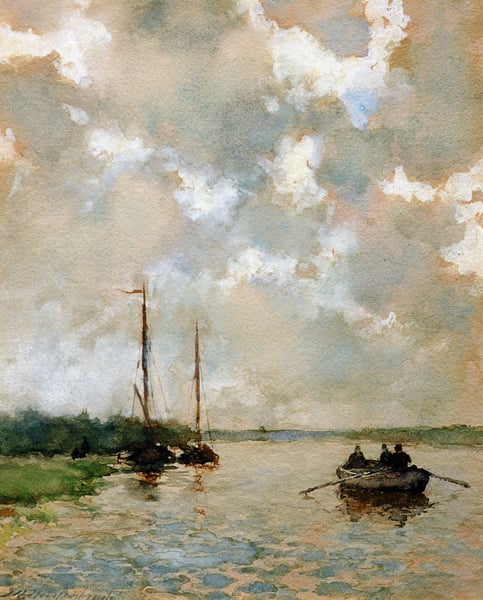
Rowing on the river
Expert analysis of Johan Hendrik Weissenbruch’s Rowing on the river
Style: Realism · Genre: landscape
Expert Analysis: "Rowing on the river" by Johan Hendrik Weissenbruch
Johan Hendrik Weissenbruch (1824–1903) was a leading figure of the Hague School, a movement that embraced Realism by turning away from idealized, romanticized landscapes toward the truthful, unembellished observation of nature. Rowing on the river exemplifies this commitment, capturing a quiet, everyday moment on a Dutch waterway with remarkable fidelity to light, atmosphere, and the subtle interplay of sky and water.
Significance within the Realist tradition
Weissenbruch’s work stands out for its masterful handling of tonality and atmosphere. In this painting, the river is not merely a backdrop for the figures rowing—it is the central subject, its surface reflecting the soft, diffused light of a cloudy sky. The artist reduces color to a restrained palette of grays, blues, and muted greens, a hallmark of the Hague School’s so-called “gray period.” This tonal unity creates a sense of tranquillity and verisimilitude, making the scene feel immediate and unposed.
The rowing boat, small and unremarkable, is placed off-center, allowing the broad expanse of water and the vast, overcast sky to dominate the composition. This choice underscores the Realist emphasis on the everyday and the commonplace—the beauty of a mundane activity, observed without sentimentality. Weissenbruch’s brushwork is loose yet precise: he uses broad, horizontal strokes for the river’s ripples and softer, broken touches for the reflections, while the sky is built from layered, feathery clouds that seem to move and shift.
What makes this artwork significant
- Mastery of aerial perspective: Weissenbruch captures the humid, hazy atmosphere of the Dutch lowlands, where the horizon often blurs into the sky. The distant riverbank is rendered softly, reinforcing the sense of depth and weather.
- Influence on later Realism: Alongside contemporaries like Anton Mauve and Jozef Israëls, Weissenbruch helped define the Hague School’s contribution to European Realism—an unflinching but poetic attention to the native landscape, studied en plein air.
- Precursor to modern landscape: By prioritizing mood and light over narrative, Rowing on the river points forward to the more atmospheric, even impressionistic tendencies that would emerge in the late 19th century. Yet Weissenbruch never sacrifices structure for effect; every element—the boat, the water, the sky—is anchored in observable reality.
In short, the painting is significant not for any dramatic event, but for its quiet, honest meditation on the Dutch landscape. It reminds us that Realism’s enduring power lies in its ability to find profound beauty in the simplest, most transient moments of daily life.
Visually similar
20 works with related composition and palette
Ships on canal
Johan Hendrik Weissenbruch
The barges in Bezons
Charles-Francois Daubigny
Ships On A Puddle
Cornelis Vreedenburgh
At the Boat Landing
William Merritt Chase
Ship in polder canal
Johan Hendrik Weissenbruch
Seascape
Louis Artan
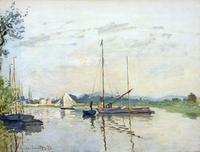
Argenteuil
Claude Monet
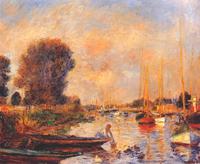
The seine at argenteuil
Pierre-Auguste Renoir
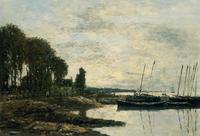
The Shore at Plougastel
Eugene Boudin
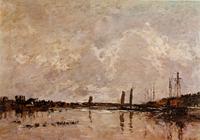
Near Faou
Eugene Boudin
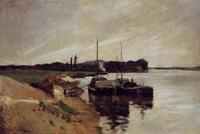
Mouth of the Seine
John Henry Twachtman
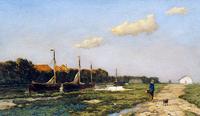
Along the canal
Johan Hendrik Weissenbruch
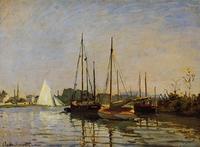
Pleasure Boats, Argenteuil, c.1872-3 (oil on canvas)
Claude Monet
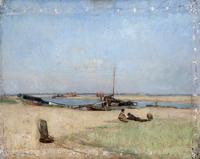
Estuary at Walberswick
Walter Osborne
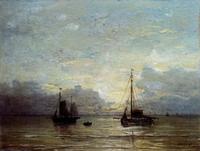
Fishing Boats Near The Coast
Hendrik Willem Mesdag
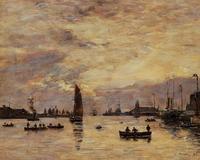
Le Havre. Avent Port.
Eugene Boudin
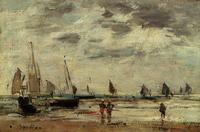
Berck, Jetty and Sailing Boats at Low Tide
Eugene Boudin
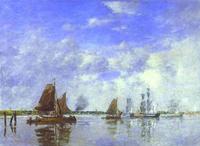
The Meuse at Dordrecht
Eugene Boudin
Trouville, the Port
Eugene Boudin
Seascape
Claude Monet