Analyse experte de The Mill at Kelf de Theo van Rysselberghe
Style : Pointillism, Neo-Impressionism · Genre : landscape
Expert Analysis: “The Mill at Kelf” by Theo van Rysselberghe
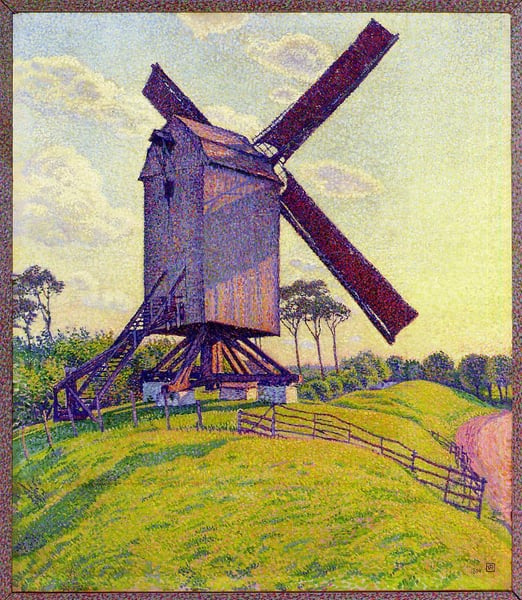
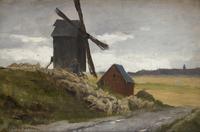
Theo van Rysselberghe’s The Mill at Kelf stands as a refined exemplar of Neo-Impressionist landscape painting, demonstrating the artist’s masterful adaptation of Georges Seurat’s pointillist technique to the nuances of northern European light and rural topography. Within the Pointillist movement, van Rysselberghe distinguished himself by infusing the strict scientific method of divided color with a lyrical, almost atmospheric sensibility—a quality vividly on display in this work.
Style and Technique
Executed entirely through tiny, discrete dots of pure pigment, the painting applies the Neo-Impressionist principle of optical mixing: the viewer’s eye blends the separate touches of color to create a luminous, vibrating surface. Van Rysselberghe’s palette here is characteristically bright yet tempered—soft greens, pale blues, and warm ochres suggest a sun-drenched, breezy afternoon. The mill itself becomes a focal point of geometric stability, its form built from carefully calibrated dashes that contrast with the looser, more organic dabs of the surrounding foliage and sky.
Significance within the Period
The Mill at Kelf is significant for several reasons:
-
Belgian Neo-Impressionism – While Pointillism was pioneered in France, van Rysselberghe was the leading exponent of the style in Belgium. He was a founding member of Les XX (Les Vingt), a progressive artistic group that championed avant-garde movements. This painting reflects the international reach of Neo-Impressionism and its adaptation to local landscapes—here, the flat, agricultural fields of Flanders or the Kempen region (Kelf possibly referring to a hamlet near Antwerp or a similar rural site).
-
Harmony of Science and Sensibility – Van Rysselberghe’s pointillism never becomes cold or mechanical. Unlike the more rigidly systematic works of Seurat or Signac, The Mill at Kelf retains a painterly softness and immediate impression of atmosphere. The mill’s silhouette is rendered with delicate color transitions that capture the shimmer of light on stone and the haze of distant trees, proving that Neo-Impressionism could evoke mood without abandoning its theoretical foundations.
-
Transitional Moment – Painted during a period when van Rysselberghe was moving toward a more decorative, linear style (which would later culminate in his Art Nouveau-inspired works), The Mill at Kelf represents a peak of his commitment to Pointillist technique. It exemplifies how the movement’s rigorous color theory could be employed to celebrate simple, everyday landscapes—a windmill, a field, a sky—elevating them into shimmering tapestries of pure optical pleasure.
Artistic Legacy
Today, this work is valued for its demonstration of Pointillism’s versatility beyond the Parisian boulevards and café-concerts. Van Rysselberghe’s sensitive handling of rural light and his ability to make the systematic pointillist dot feel organic and responsive to nature mark The Mill at Kelf as a significant contribution to the Neo-Impressionist canon—a serene yet intellectually rigorous landscape that bridges the analytical color theories of the 1880s with the decorative harmonies of the early twentieth century.
Museum / Gallery
Visuellement similaire
20 œuvres à la composition et à la palette proches
Mill of Heeswijk Sun
Piet Mondrian
Windmills, Blackheath
Edward William Cooke
Moulin (Somme)
Eugène Atget
Le Moulin de la Galette 4
Vincent van Gogh
The Mill on the Het Blauwhoofd
Rembrandt
Windmill
David Cox
The Knocke Windmill, Belgium
Camille Pissarro

Windmills in the Ukrainian steppe at sunset
Ivan Aivazovsky
Gardens on Montmartre and the Blute-Fin Windmill
Vincent van Gogh
A Windmill near Brighton
John Constable
The big connection channel at Southall Mill
J.M.W. Turner
Landscape with watermill
Jacob van Strij
Cayeux, Windmill in the Countryside, Morning
Eugene Boudin
Le Moulin de la Gallette
Vincent van Gogh
Le Moulin de la Gallette 3
Vincent van Gogh
Landscape at Noorden
Johan Hendrik Weissenbruch
Windmills
Roman Selsky
Windmill
Nicholas Roerich
Eenden in de sloot bij een molen rechtsonder get
Louwrens Hanedoes
Windmill at Nauroy
Julien Dupré