Theo van Rysselberghe の The Scarlet Ribbon の専門的な分析
スタイル:Pointillism, Neo-Impressionism · ジャンル:nude painting (nu)
Expert Analysis of "The Scarlet Ribbon" by Theo van Rysselberghe
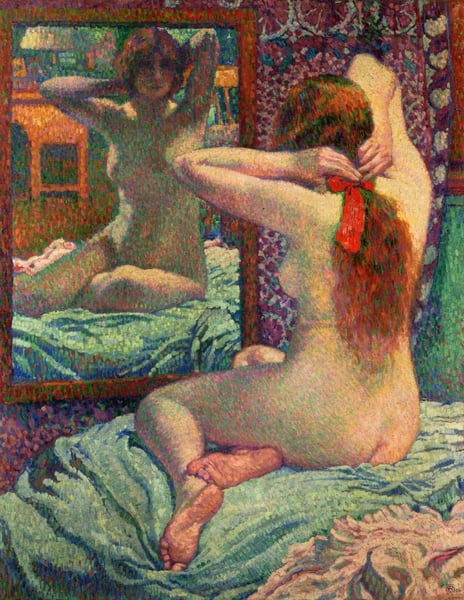
Theo van Rysselberghe’s The Scarlet Ribbon stands as a masterful example of Neo-Impressionist figure painting, demonstrating the Belgian artist’s distinctive adaptation of Georges Seurat’s pointillist technique to the human form. Unlike many of his contemporaries, who favored landscapes and seascapes for pointillist exploration, van Rysselberghe applied the systematic division of color to the nude—a genre that demands both refined draftsmanship and sensitivity to flesh tones.
Significance within Neo-Impressionism
This work is significant for its rigorous yet lyrical use of optical mixing. Van Rysselberghe builds the model’s skin through countless tiny dots of complementary colors—pink, ochre, blue, and green—which, when viewed from a distance, coalesce into a luminous, living surface. The technique avoids muddying pigments on the palette, instead allowing the viewer’s eye to fuse them, creating a shimmering effect that suggests both texture and atmosphere.
The titular scarlet ribbon serves as a visual anchor. Its intense, unmodulated red (applied with larger, more emphatic dots) contrasts sharply with the pale skin, drawing the eye to the figure’s hair and neck. This accent also demonstrates van Rysselberghe’s understanding of Chevreul’s law of simultaneous contrast: the red intensifies the surrounding greens and blues of the background, while the background’s cool tones in turn make the ribbon appear even more vibrant.
Composition and Psychological Depth
The composition eschews the artificiality of studio nudes of the period. The model is positioned in a relaxed, almost candid pose, her gaze averted, lending an air of introspective calm. The pointillist dots, rather than being mechanical, are varied in density—denser and warmer on the face and torso, looser and cooler in the shadows. This subtle modulation gives the body volume without sacrificing the surface pattern that defines Neo-Impressionism.
Van Rysselberghe’s skill lies in balancing the scientific precision of pointillism with a genuine sensuality. The Scarlet Ribbon is not a mere exercise in color theory; it is a testament to how a systematic technique can still convey the softness of skin, the weight of hair, and the quiet presence of a person. In doing so, it expanded the possibilities of Neo-Impressionism beyond the anecdotal or the monumental, proving that the dot could capture intimacy as effectively as it captured light.
Museum / Gallery
視覚的に類似
構図やパレットが近い作品 20 件
Woman Combing Her Hair
Edgar Degas
Reclining Nude
Roderic O'Conor
The Bather
Theo van Rysselberghe
Woman at Her Toilette
Theo van Rysselberghe
After the Bath
Edgar Degas
Siesta
Pierre Bonnard
The sun's rays
Hovsep Pushman
After the Bath
Edgar Degas
Intimacy
Theodor Pallady
After the Bath
Edgar Degas
Venetian Woman (Marcella)
Theo van Rysselberghe
Nude
Zinaida Serebriakova
Model with red hair by the mirror
Pyotr Konchalovsky
The Model
William Merritt Chase
Woman Combing Her Hair
Edgar Degas
Suzanne Sewing - Study of a Nude
Paul Gauguin
Sleeping Nude with Hat (Repose)
Pierre-Auguste Renoir
Leaving the Bath
Edgar Degas
Nude With a Green Shawl
Henri Matisse
Reclining Nude
Pierre-Auguste Renoir