Analisi esperta di The Beach at Tourgeville-les-Sablons di Eugene Boudin
Stile: Impressionism · Genere: landscape
Expert Analysis: The Beach at Tourgeville-les-Sablons by Eugène Boudin
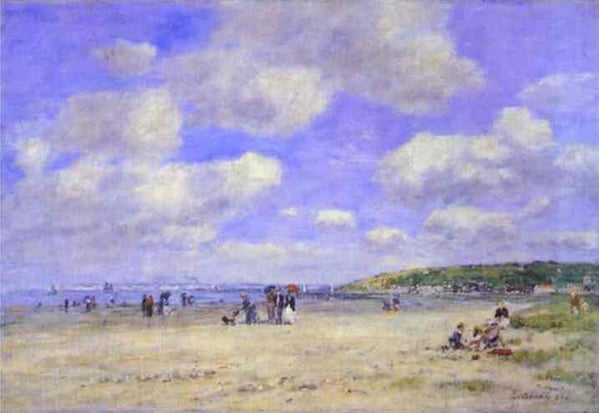
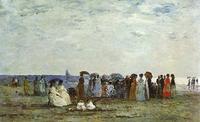
Eugène Boudin’s The Beach at Tourgeville-les-Sablons stands as a quintessential example of early Impressionist landscape painting, revealing the artist’s pivotal role in the transition from academic realism to the spontaneous, light-filled vision of the Impressionists. Executed in the latter half of the 19th century, the work captures a breezy, ordinary seaside moment on the Normandy coast—a subject Boudin made distinctly his own.
Significance within Impressionism and Boudin’s Oeuvre:
-
Pioneering Plein Air Practice – Boudin was one of the first French artists to paint outdoors (en plein air) with the explicit goal of recording atmospheric conditions and transient light. This beach scene, with its shifting clouds, shimmering water, and figures animated by the sea breeze, exemplifies his commitment to capturing a specific time of day and weather. He famously advised the young Claude Monet to “paint directly from nature,” and this work embodies that credo.
-
Mastery of Sky and Atmosphere – The painting’s most striking feature is its expansive, cloud-filled sky, which Boudin treats as the emotional and structural core of the composition. He once called the sky “the dominant note of the landscape,” and here its blues, grays, and whites are rendered in swift, broken brushstrokes that convey movement and moisture. The horizon line is kept low, allowing the sky to occupy nearly two-thirds of the canvas, while the beach and sea are reduced to broad, luminous planes. This focus on atmospheric effect directly anticipates Monet’s later series of haystacks and cathedrals.
-
Modern Life and Leisure – Boudin’s beach scenes are among the first to depict the new social phenomenon of bourgeois seaside tourism. The scattered figures (holidaymakers, perhaps a nurse with a child) are not heroic or narrative but are instead integrated into the landscape as fleeting accents of color and activity. This shift toward everyday modern life, rendered with casual observation rather than moral or historical weight, aligns perfectly with the Impressionist emphasis on the contemporary.
-
Color and Light – Boudin uses a restrained but nuanced palette: sandy ochres, soft blues, and crisp whites. His touch is light and feathery, avoiding sharp outlines. Shadows are not black but reflected hues from the sky and water. The wet sand gleams with sky tones, and the distant cliffs dissolve into mist—techniques that later Impressionists would push further but which Boudin pioneered in the 1860s and 1870s.
-
Historical Role – While often called a “precursor” to Impressionism, Boudin’s work is not merely preparatory; it is a fully realized artistic statement. The Beach at Tourgeville-les-Sablons displays the key Impressionist tenets—spontaneity, brightness, and the primacy of optical perception—before the movement had a name. He was the only major painter of the group to focus almost exclusively on seascapes and coastal scenes, making his contribution unique.
In summary, this painting is significant because it bridges the naturalism of the Barbizon school and the revolutionary color experiments of Impressionism. Boudin’s ability to freeze a moment of atmospheric flux with such economy and freshness makes this work a vital document of the Impressionist revolution in landscape painting.
Museum / Gallery
Visivamente simili
20 opere con composizione e palette affini
Rhyl Sands
David Cox
The beach at Deauville
Eugene Boudin
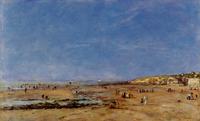
Trouville, Panorama of the Beach
Eugene Boudin
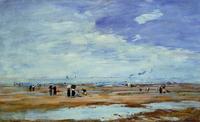
Deauville, the Beach, Low Tide
Eugene Boudin
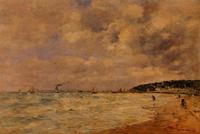
The Tourgeville Shores
Eugene Boudin
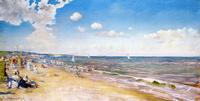
The Beach at Zandvoort
William Merritt Chase
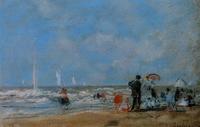
On the Beach
Eugene Boudin
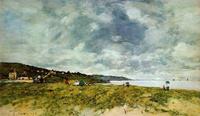
The Shore at Tourgeville
Eugene Boudin
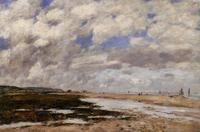
The Beach, Deauville
Eugene Boudin
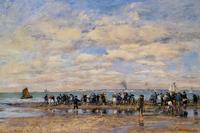
Trouville, the Beach at Low Tide
Eugene Boudin
Rhyl Sands
David Cox
Beach Scene
Eugene Boudin
The Coastline at Plougastel
Eugene Boudin
Rocks with Shrimp Fishermen
Pierre-Auguste Renoir
Stormy Weather, Pas de Calais
Camille Corot
Beach at Trouville
Eugene Boudin
CHILDREN BY THE SEASIDE
Nathaniel Hone the Younger
Plougastel, Women Waiting for the Ferry
Eugene Boudin
Bathers on the Beach at Trouville
Eugene Boudin
Beach Scene
Samuel Peploe