Expert analysis of Camille Corot’s Stormy Weather, Pas de Calais
Style: Realism · Genre: landscape
Expert Analysis: Stormy Weather, Pas de Calais by Camille Corot
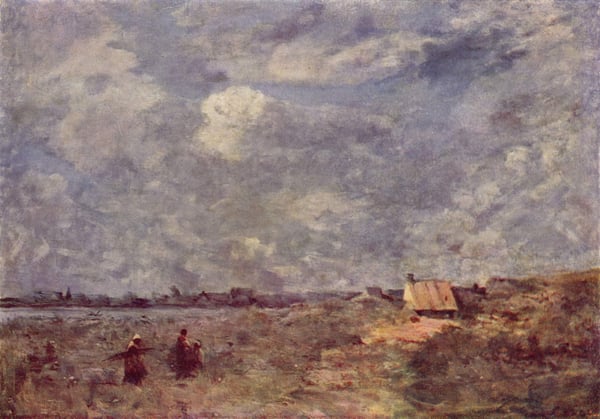
Camille Corot’s Stormy Weather, Pas de Calais (c. 1870–1875) stands as a pivotal work within the Realist landscape tradition, embodying the movement’s core ambition to depict nature with unidealized fidelity while retaining a deeply poetic sensibility. Painted late in Corot’s career, the work exemplifies his mature synthesis of direct observation and atmospheric subtlety—qualities that would profoundly influence the subsequent generation of Impressionists.
Significance within Realism and its Period
1. Realism’s Shift from Grandeur to Intimacy
Unlike the heroic, ordered landscapes of the Neoclassical tradition (e.g., Poussin, Lorrain), Corot here focuses on a transient, everyday meteorological event: a storm rolling over the flat, windy coast of the Pas de Calais in northern France. The sky dominates the composition—low, bruised clouds churn toward the horizon, while a pale break in the clouds suggests a fleeting moment of light. Corot renders the grasses and dunes with loose, abbreviated brushwork, prioritizing the visual sensation of weather over precise botanical detail. This aligns with Realism’s rejection of theatrical composition in favor of unembellished, quotidian nature.
2. Mastery of Atmospheric Tone
Corot’s signature “silvery” palette—muted greens, cool grays, and soft ochres—creates a unified, hazy atmosphere that blurs the boundary between earth and sky. The wind is palpable: diagonal strokes in the clouds and the bent forms of coastal vegetation convey movement without overt drama. This tonal harmony, achieved through meticulous layering and glazing, was Corot’s hallmark. It elevates the scene beyond a mere meteorological record into a meditation on the transient beauty of natural light—a concern that directly anticipates Monet’s Impression, Sunrise and the Impressionist obsession with atmospheric effects.
3. Bridge between Realism and Impressionism
Corot is often called the “father of Impressionism,” and Stormy Weather, Pas de Calais demonstrates why. While the composition remains grounded in Realist observation (the horizon line is stable, the space is legible), the broken handling of the clouds and the suggestive texture of the foreground verge on the sketch-like freedom of plein-air painting. Corot’s willingness to let the paint’s materiality speak—the thick impasto in the sky, the scumbled strokes in the grasses—allowed a new generation of artists to see that a landscape could be both faithful to nature and a record of the artist’s immediate, personal response.
Conclusion
Stormy Weather, Pas de Calais is significant not merely as a fine example of Realist landscape, but as a work that pushes Realism toward its logical successor. Corot captures the raw, unvarnished face of nature—a storm that is neither allegorical nor heroic—and in doing so, he creates a quiet, luminous image that feels both timeless and utterly modern. It is a testament to his belief that the truest poetry lies not in invented grandeur, but in the fleeting, weather-worn poetry of the real world.
Museum / Gallery
Visually similar
20 works with related composition and palette
Flowering field
Ion Andreescu
《戈壁绿洲 植树前》
风尚秀士
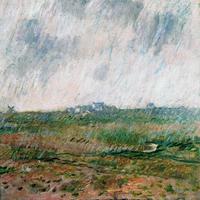
Rain in Belle-Ile
Claude Monet
The away Samson in Grandcamp
Georges Seurat
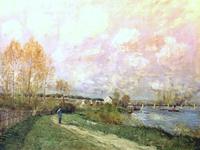
Summer at Bougival
Alfred Sisley
Windward
Henri Martin
Near the Bank of the Seine at By
Alfred Sisley
Path to Le Chou, Pontoise
Camille Pissarro
Young corn
Charles-Francois Daubigny
The Banks of the Seine at Champrosay
Pierre-Auguste Renoir
Valhermeil near Oise, Rain effect
Camille Pissarro
Banks of the Seine at Champrosay
Pierre-Auguste Renoir
The Road to Louveciennes Montbuisson
Alfred Sisley
Walnut Trees, Sunset Early Days of October
Alfred Sisley
Autumn Landscape
Narcisse-Virgilio Diaz
Plougastel, Women Waiting for the Ferry
Eugene Boudin
The Shore at Tourgeville
Eugene Boudin
Haystack
Alfred Sisley
Flying Shadows
Willard Metcalf
Springtime
Claude Monet