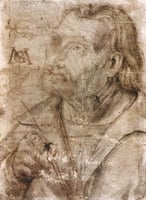
Expertenanalyse zu Matthias Grünewalds Woman Looking Up
Stil: Northern Renaissance · Genre: portrait
Analysis of "Woman Looking Up" by Matthias Grünewald
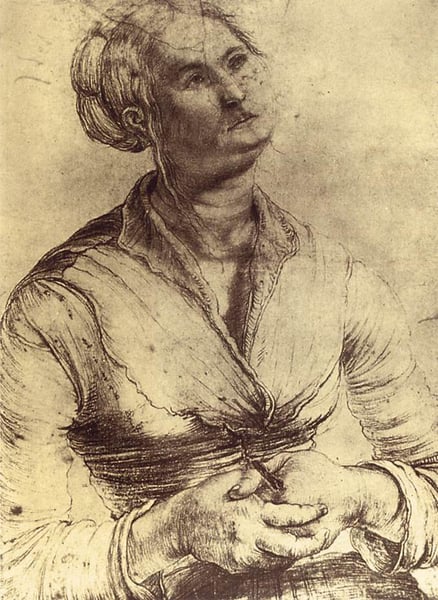
This work is a portrait from the Northern Renaissance, a period renowned for its intense naturalism, symbolic depth, and emotional intensity. Matthias Grünewald, primarily celebrated for his monumental religious altarpieces (most famously the Isenheim Altarpiece), is rarely associated with standalone portraiture. Therefore, Woman Looking Up occupies a significant if unusual place within his oeuvre and the Northern Renaissance portrait tradition.
Significance within the Northern Renaissance:
-
Rarity and Artistic Range
Grünewald’s surviving works are almost exclusively religious narratives. A secular portrait—especially one depicting an anonymous woman—is exceptionally rare for him. This suggests either a private commission or a study of human expression, highlighting the artist’s versatility beyond the altarpiece format. -
Emotional and Spiritual Intensity
The title’s focus on "looking up" implies a crucially upward gaze, a device typical of Northern Renaissance painting to convey spiritual yearning, divine revelation, or introspective prayer. In the context of the period’s fascination with inner life, Grünewald likely infused this portrait with the same anguished or ecstatic emotional energy found in his religious works, making it a bridge between the sacred and the personal. -
Naturalism and Psychological Depth
Northern Renaissance artists prized meticulous detail and the rendering of human individuality. A portrait of a woman looking up would require precise anatomical foreshortening—a challenge that Grünewald’s bold, often distorted figures (as in the Isenheim crucifixion) suggest he approached with expressive rather than purely academic anatomy. This tension between realism and emotional distortion sets the work apart from more placid contemporary portraits by artists like Dürer or Memling. -
Use of Light and Color
Though no specific palette is noted, Grünewald’s known color sense is vivid, even jarring—vermillion reds, acid greens, and deep blues. In a portrait, such colors would dramatize the upward gaze, perhaps casting dramatic shadows (chiaroscuro) that accentuate the subject’s spiritual or emotional state. This aligns with the Northern Renaissance trend of using light symbolically, to indicate divine presence or inner illumination.
What Makes It Significant Within Its Style/Period:
- It is a rare solo portrait by an artist famous for polyptychs, expanding our understanding of Grünewald’s subject matter.
- The upward gaze exemplifies the Northern Renaissance’s blend of naturalistic observation and symbolic transcendence, where a simple gesture becomes a statement about the soul’s relation to the divine.
- It challenges the typically calm, self-contained Northern portrait, introducing a dynamic, almost restless energy that looks forward to Mannerist and Baroque expressions.
In essence, Woman Looking Up stands as a compelling outlier in Grünewald’s body of work—a portrait that, through its direct emotional appeal and compositional daring, encapsulates the Northern Renaissance’s drive to capture both the visible world and the invisible spirit.
Museum / Gallery
Visuell ähnlich
20 Werke mit ähnlicher Komposition und Farbpalette
Portrait of a woman (Agnes Dürer)
Albrecht Durer
Seated Woman
Vincent van Gogh
Seated Woman
Albrecht Durer
Bust of a young lady
Marià Fortuny
Endres Dürer, brother of the painter, in profile
Albrecht Durer
Portrait of a Young Woman
Peter Paul Rubens
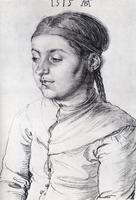
Portrait Of A Girl
Albrecht Durer
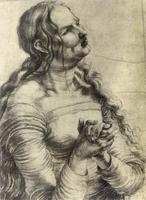
Weeping Woman
Matthias Grünewald
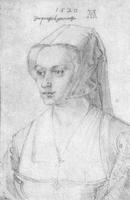
Portrait of a woman from Brussels
Albrecht Durer
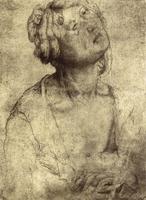
Woman with Open Robe
Matthias Grünewald
Portrait of T. A. Mamontova
Ilya Repin
Portrait of Margaret of Brandenburg Ansbach
Albrecht Durer
A Young Woman with a Basket
Rembrandt
Seated Woman
Adriaen van de Velde
Portrait of Woman
James Tissot
Young man in bust
Alfred Dehodencq
Madame Charles Gounod, born Anna Zimmermann
Jean Auguste Dominique Ingres
Half figure of a woman holding out a flower
Giovanni Battista Piranesi
Schepkina Yelena
Vasily Tropinin
Portrait of a young woman
Albrecht Durer