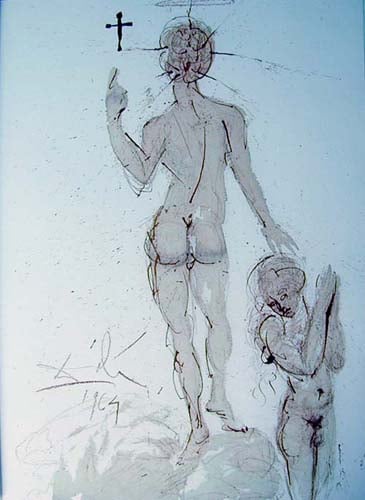
Asperges me hyssopo et mundabor
Dettagli
Analisi esperta di Asperges me hyssopo et mundabor di Salvador Dali
Stile: Expressionism, Symbolism · Genere: religious painting
Expert Analysis of "Asperges me hyssopo et mundabor" by Salvador Dalí
Dalí's "Asperges me hyssopo et mundabor" is a compelling religious painting from his Classic Period (1941–1989), a phase marked by his return to Catholic faith and a synthesis of traditional techniques with his earlier avant-garde tendencies. The work draws its title from Psalm 51, a plea for spiritual purification ("Purge me with hyssop, and I shall be clean"), and reflects Dalí’s profound engagement with Christian iconography during this mature period.
Significance within Expressionism and Symbolism
Though Dalí is legendary as a Surrealist, this painting exemplifies his later adoption of Expressionism and Symbolism—styles that prioritize emotional intensity and layered meaning over literal representation. The expressionist qualities are evident in the distorted, fluid forms and dramatic chiaroscuro, which convey a sense of divine anguish and ecstatic redemption. The symbolic dimension is equally potent: the hyssop branch (a biblical instrument of purification) becomes a central motif, while the figure’s elongated, almost skeletal anatomy evokes both human frailty and the transcendence of the soul. Dalí’s use of religious symbolism here is not merely illustrative but deeply personal, channeling his own guilt, repentance, and hope for absolution.
Significance within Dalí’s Classic Period
This artwork is a hallmark of Dalí’s Classic Period, a time when he deliberately turned away from the irrational automatism of Surrealism toward a more structured, classical style infused with religious and scientific themes. The painting’s composition—with its stark, theatrical lighting and monumental, sculptural figure—echoes the Old Masters (such as El Greco or Zurbarán) whom Dalí revered. Yet the emotional rawness and distorted anatomy betray his expressionist impulses, creating a fusion of sacred tradition and modern anxiety. This tension between the archaic and the contemporary is what makes the piece significant: it represents Dalí’s attempt to reconcile his avant-garde past with his newly rediscovered faith, producing a work that is both a devotional image and a psychological self-portrait.
Overall Significance
"Asperges me hyssopo et mundabor" stands as a testament to Dalí’s versatility and his ability to transform personal religious fervor into a universal statement of human longing for purity. Within the context of his classic phase, it exemplifies his unique contribution to 20th-century religious art—a blend of symbolic depth, expressionist fervor, and classical discipline that challenges the viewer to see the divine through the lens of modern anxiety. Its power lies in its ability to evoke both the agony of sin and the hope of salvation, making it a lasting example of Dalí’s spiritual and artistic evolution.
Visivamente simili
20 opere con composizione e palette affini
Artist's Model from the back
Kuzma Petrov-Vodkin
Kondor Béla, Három Akt
Kondor Béla
A standing nude
Jan Sluyters
The Model
Kuzma Petrov-Vodkin
Vajda Lajos 1924 Női Akt Akvarell, 275x250 Mm
Vajda Lajos
The Nymph
Karl Bryullov
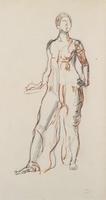
Standing draped figure
Ferdinand Hodler
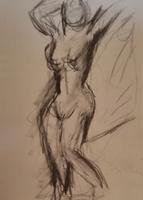
Nude Standing
Bela Czobel
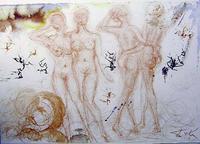
Stultae et prudentes Filiae (Sirach 7:26)
Salvador Dali
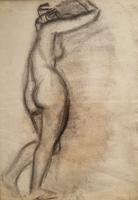
Modok Mária, Akt Tanulmány
Modok Mária
Untitled
Eugene Leroy
The Model
Kuzma Petrov-Vodkin
Nude
Bela Czobel
Idol
Vincent van Gogh
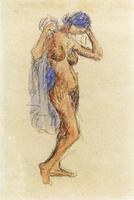
Nude Model with Drapery
Maurice Prendergast
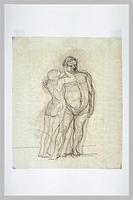
Hercule forain
Honore Daumier
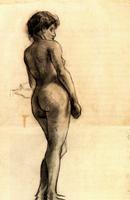
Standing Female Nude Seen from the Back
Vincent van Gogh
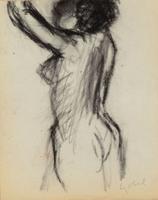
Nude
Bela Czobel
Idol
Vincent van Gogh
Idol
Vincent van Gogh