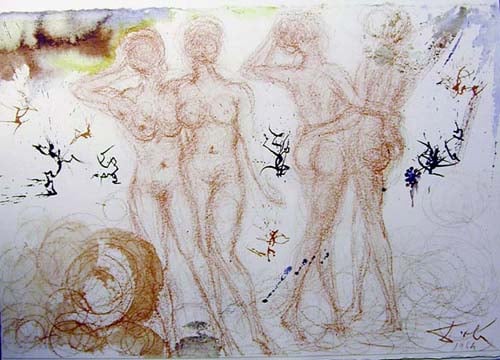
Stultae et prudentes Filiae (Sirach 7:26)
Ayrıntılar
Salvador Dali sanatçısının Stultae et prudentes Filiae (Sirach 7:26) eseri hakkında uzman analizi
Tarz: Expressionism, Symbolism · Tür: religious painting
Expert Art Historical Analysis:
Salvador Dalí’s Stultae et prudentes Filiae (Sirach 7:26) is a significant work from his Classic Period (1941–1989), a phase marked by a return to traditional religious subjects fused with the painter’s enduring surrealist imagination. Although the title alludes to the biblical parable of the Wise and Foolish Virgins (often associated with Matthew 25), the citation to Sirach 7:26—a verse concerning the care of daughters—adds a layer of scriptural nuance that Dalí deliberately recontextualizes.
Stylistic Significance:
The painting’s dual classification as Expressionism and Symbolism reveals Dalí’s mature approach. The expressionistic handling heightens emotional intensity through distorted forms and stark contrasts, while the symbolic vocabulary—typical of his later work—encodes moral and spiritual dichotomies. The stultae (foolish) and prudentes (wise) virgins are rendered not as narrative figures but as archetypes of human folly and wisdom, their gestures and drapery conveying inner states rather than physical reality. Dalí’s precise draftsmanship, rooted in academic tradition, is deliberately subverted by expressive brushstrokes that suggest psychological turbulence.
Religious and Symbolic Context:
As a religious painting from Dalí’s Classic Period, the work reflects his evolving fascination with Catholic mysticism and esoteric symbolism. The period often saw Dalí blending surrealist dream logic with Renaissance compositional order; here, the paradoxical fusion of turbulent expressionism and emblematic symbolism creates a visual meditation on virtue and vice. The inclusion of the phrase “Sirach 7:26” in the title signals Dalí’s deliberate engagement with apocryphal or deuterocanonical texts, further distancing the work from conventional biblical illustration and aligning it with his personal symbolic system.
Period Relevance:
Dalí’s Classic Period was his most prolific for religious art, driven by his 1949 declaration of “nuclear mysticism.” Stultae et prudentes Filiae exemplifies this era’s hallmark: the reconciliation of spiritual transcendence with material form. The expressionist energy prevents the painting from becoming a mere academic exercise, while its symbolic density invites endless interpretation. It stands as a testament to Dalí’s ability to reanimate ancient religious narratives through a modern, psychologically charged lens—making the work a cornerstone of his later oeuvre and a key example of how Expressionism and Symbolism could serve sacred themes in the mid-to-late 20th century.
Görsel olarak benzer
İlişkili kompozisyon ve renk paletine sahip 20 eser
Naked man
George Bouzianis
Asperges me hyssopo et mundabor
Salvador Dali
Nude
Bela Czobel
In the Bath
Beatrice Wood
Two female nudes
Gustave Buchet
Czobel Bela Nude
Bela Czobel
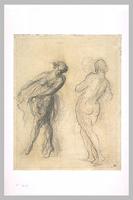
Two sketches for a dancer
Honore Daumier
Untitled
Eugene Leroy
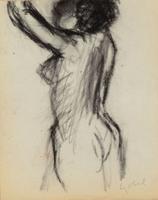
Nude
Bela Czobel
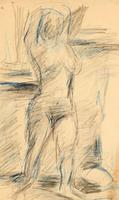
CZbel Bela Fürdés Után
Bela Czobel
Two, But Not Two
Romare Bearden
Bela Adalbert Czobel, Akt
Bela Czobel
Nude Sitting
Bela Czobel
Modok Mária, Akt Tanulmány ,,,
Modok Mária
Couple
Ernst Ludwig Kirchner
Senza Titolo
Bruno Cassinari
The temptation of Eve by the serpent
Hieronymus Bosch
Kondor Béla, Három Akt
Kondor Béla
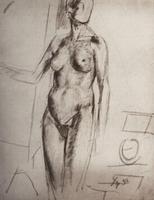
The Model
Kuzma Petrov-Vodkin
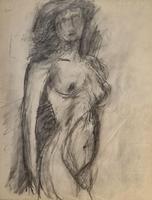
Béla Czóbel Female Nude
Bela Czobel