Er tu, puer, prophetia altissimi (Luke 1:76)
詳細
Salvador Dali の Er tu, puer, prophetia altissimi (Luke 1:76) の専門的な分析
スタイル:Expressionism, Symbolism · ジャンル:religious painting
Expert Analysis: Salvador Dalí’s “Er tu, puer, prophetia altissimi (Luke 1:76)” (c. 1960s)
This work belongs to Dalí’s Classic Period (1941–1989), a phase marked by his return to traditional techniques, religious subject matter, and a synthesis of Renaissance structure with his own surrealist vocabulary. Despite the artist’s well-known Surrealist roots, here the painting is classified under Expressionism and Symbolism—a deliberate shift that underscores its emotional intensity and layered theological meaning.
Significance within Style and Period
1. Expressionism in a Religious Context
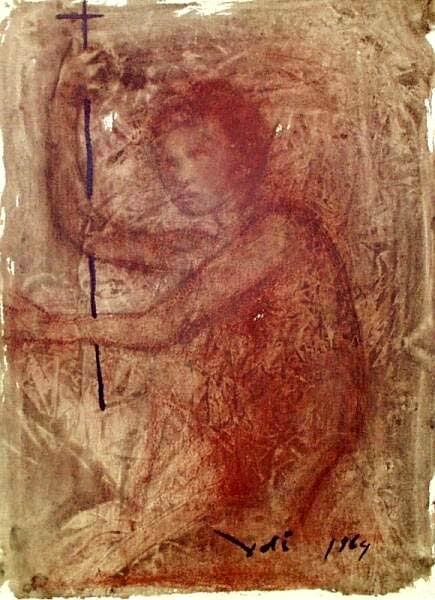
Dalí channels raw, visceral emotion through distorted forms and dramatic chiaroscuro. The figure of the young John the Baptist (the “puer” of the title) is rendered with elongated, almost trembling limbs, echoing the anguish and ecstasy of divine prophecy. Unlike the cool precision of his earlier Surrealist works, this piece prioritizes psychological weight over dreamlike dislocation. The background—a stormy, molten sky—heightens the sense of spiritual turmoil, aligning with Expressionist aims to externalize inner states.
2. Symbolism as Theological Layering
The title quotes Luke 1:76 (“And you, child, will be called the prophet of the Most High”), referring to John the Baptist’s role as herald of Christ. Dalí employs dense symbolic motifs:
- The vertical staff (a traditional attribute of John) becomes a crucifix-like axis, merging the Baptist’s mission with Christ’s sacrifice.
- A floating, fragmented halo suggests both sanctity and the brokenness of human understanding.
- The child’s upward gaze and open mouth evoke the moment of prophetic inspiration, a direct channel to the divine—a hallmark of Dalí’s later fascination with nuclear mysticism and religious iconography.
3. The Classic Period’s “Double Imagery” Revolution
During this period, Dalí pioneered his “double-image” and “paranoiac-critical” techniques within a classical framework. Here, the folds of the child’s garment subtly form a second profile—perhaps of Zachariah (his father) or an angel—creating a visual pun on the biblical generation of prophecy. This is not mere trickery but a theological statement: the prophet carries his lineage and message within his own form.
4. Counterpoint to Modernism
In an era dominated by Abstract Expressionism and Pop Art, Dalí’s return to religious narrative and meticulous realism was deliberately reactionary. “Er tu, puer…” stands as a manifesto of his belief that the highest art fuses technical mastery with transcendent meaning. By blending Expressionist agitation with Symbolist code, he creates a bridge between traditional sacred art and the psychological upheaval of the 20th century.
Conclusion
This painting is significant as a focal point of Dalí’s spiritual and technical synthesis. It demonstrates his ability to reimagine biblical themes through a lens of modern anxiety and ancient ritual, proving that the Classic Period was not a retreat but a radical redefinition of religious painting as both personal confession and universal symbol.
視覚的に類似
構図やパレットが近い作品 20 件
Woman figure
George Bouzianis
Silueta
Lilia Carrillo
Old Woman stretching out her hands to the fire
Pablo Picasso
Germination
Jacques Hérold
Liza Kottou
George Bouzianis
So Certain I Was a Horse
Betty Goodwin
Nude Woman Curled Up
Lucien Levy-Dhurmer
Untitled (Women Series)
Nalini Malani
Man in red
Chronis Botsoglou
Mellowing
Vladimir Davidia
Woman and Stone Pot Full of Flowers
Odilon Redon
Nu noir
Jean Fautrier
Nude Figures in a Room
Alexandre Jacovleff
Nu feminin allongé
Jean Fautrier
Tribute to Bouzianis
Chronis Botsoglou
Pardon
Oleg Holosiy
Untitled
Margareta Sterian
Study for scene from tannhauser
Pierre-Auguste Renoir
Study of a Statuette by Maillol
Pierre-Auguste Renoir
Female Dancers
George Bouzianis