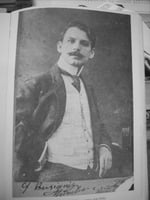
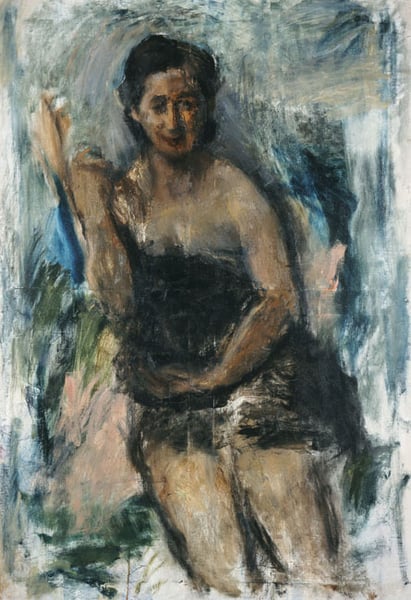
Expert analysis of George Bouzianis’s Liza Kottou
Style: Expressionism · Genre: portrait
Expert Analysis: "Liza Kottou" by George Bouzianis
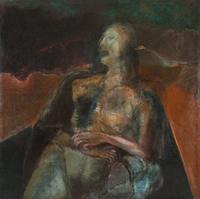
George Bouzianis (1885–1959) is celebrated as a pioneering figure in Greek Expressionism, and his portrait "Liza Kottou" stands as a compelling testament to his mastery of emotional truth over literal representation. Executed in the Expressionist tradition, the work discards mimetic accuracy in favor of psychological intensity, using vivid distortion and dynamic brushwork to penetrate the sitter’s inner life.
Significance within Expressionism and Bouzianis’s Oeuvre
The portrait’s significance lies in how it synthesizes the core concerns of Expressionism—subjective emotion, heightened color, and formal tension—with a distinctly Mediterranean sensibility. Bouzianis, who trained in Munich and was influenced by German Expressionists like Ernst Ludwig Kirchner, nevertheless eschewed their often anguished urban themes. Instead, he turned to portraiture as a vehicle for exploring the raw, unguarded humanity of his subjects. In *"Liza Kottou," the face is likely rendered with exaggerated planes, audacious color contrasts (perhaps saturated ochres, deep blues, or unnatural greens), and a loose, almost violent application of paint. These choices are not decorative but structural: they deform the features to convey a sense of vulnerability, resilience, or melancholic introspection, depending on the viewer’s encounter.
Why This Work Matters
First, it exemplifies Bouzianis’s late-modernist breakthrough. Where earlier Greek painters adhered to academic naturalism, Bouzianis embraced Expressionism’s liberating subjectivity, making "Liza Kottou" a document of cultural shift—a rejection of the picturesque in favor of the visceral. Second, the portrait’s significance is intensified by its potential to challenge the viewer’s own emotional landscape. The expressive distortion of Kottou’s likeness—perhaps through asymmetrical eyes, elongated neck, or jagged contour lines—does not alienate but rather invites a deeper empathy. This aligns with Expressionism’s mission: to make the invisible visible.
Finally, within Bouzianis’s own career, such portraits anchor his reputation as a “painter of the soul.” Unlike many of his contemporaries who eventually tempered their styles, Bouzianis remained radical, and "Liza Kottou" stands as a testament to his unyielding commitment to emotional authenticity. It is not merely a portrait of a woman named Liza Kottou, but a portrait of an entire artistic ethos—one that values the tremor of a brushstroke over the precision of a line.
Museum / Gallery
Visually similar
20 works with related composition and palette
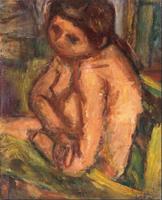
Czobel Béla Half Nude
Bela Czobel
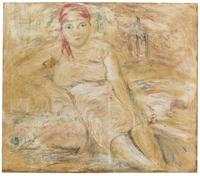
Juanita sentada (descanso)
Armando Reveron
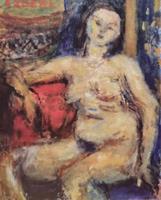
Seated Nude
Bela Czobel
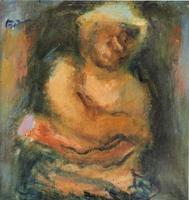
Woman figure
George Bouzianis
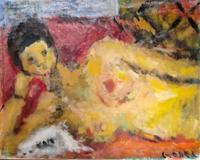
Félakt
Bela Czobel
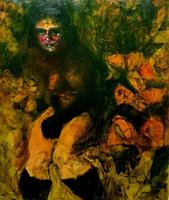
Mellowing
Vladimir Davidia
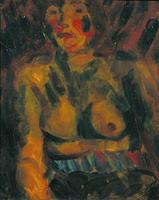
Half Length Nude
Matthew Smith
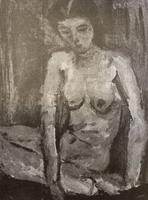
Bela Czobel, Nu Assis 1928
Bela Czobel
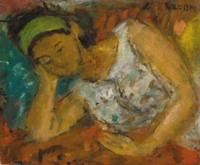
Czóbel Béla Könyöklő Lány
Bela Czobel
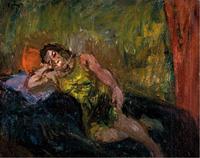
Berény Róbert, Pihenő Lány,
Berény Róbert
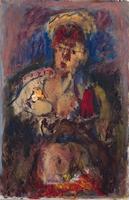
Woman with Flowers
George Bouzianis
Lilian
David Bomberg
Seated female nude
Pablo Picasso
Nude
Bela Czobel
Vera Cuningham. Head and Shoulders
Matthew Smith
Actress
George Bouzianis
Nude Seated in a Landscape
Pierre-Auguste Renoir
Modok Mária, Sárga Akt 1936
Modok Mária

Act under Moonlight
Vera Nedkova
Untitled (Women Series)
Nalini Malani