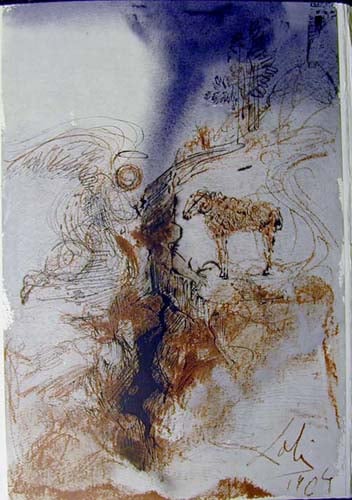
Hircus caprarum super faciem terrae
Ayrıntılar
Salvador Dali sanatçısının Hircus caprarum super faciem terrae eseri hakkında uzman analizi
Tarz: Expressionism, Symbolism · Tür: religious painting
Expert Analysis of Salvador Dalí’s Hircus caprarum super faciem terrae (c. 1950s, Classic Period)
This painting, whose Latin title translates to “Goat of goats upon the face of the earth,” stands as a compelling testament to Dalí’s mature religious phase, often referred to as his Classic Period (1941–1989). During this era, Dalí abandoned the purely irrational automatism of his earlier Surrealism in favor of a meticulously controlled, Renaissance-inspired technique fused with deeply symbolic, often apocalyptic Christian imagery. The work is a religious painting executed in an Expressionist and Symbolist mode, marking a pivotal moment in Dalí’s personal and artistic reconciliation with Catholicism.
Significance Within Style and Period
1. Synthesis of Expressionist Emotion and Symbolist Meaning
Dalí channels the Expressionist intensity through dramatic chiaroscuro, distorted anatomy, and a charged, tempestuous atmosphere. The goat—a traditional symbol of lust, sin, and the scapegoat (as in Leviticus 16)—is rendered with visceral, almost violent brushwork, its cloven hooves and horned silhouette looming over a desolate landscape. Yet the Symbolist layer elevates the image: the goat is not merely a beast but an allegorical embodiment of earthly corruption or the “Goat of Mendes” (a heretical deity conflated with Satan in occult lore). Dalí reinterprets this symbol within a Catholic framework, suggesting the weight of original sin pressing upon the world.
2. Apocalyptic Religious Imagery in Dalí’s Classic Period
After the atomic bombings of 1945, Dalí became obsessed with nuclear mysticism and the fusion of science and faith. Here, the “face of the earth” is depicted as a barren, cratered terrain—a post-apocalyptic Golgotha. The goat stands atop a craggy rock, its elongated limbs echoing Dalí’s signature “soft” distortions, yet the composition is sternly classical, recalling the asceticism of early Renaissance panel painting (e.g., Grünewald’s Isenheim Altarpiece). This tension between Expressionist disquiet and Symbolist theological complexity marks Dalí’s shift from Surrealist provocation to a devout, though idiosyncratic, religious art.
3. Thematic Significance: Sin, Sacrifice, and Salvation
The Latin title carries an almost scriptural weight (“upon the face of the earth” echoes Genesis and Revelation). Dalí deliberately invokes the scapegoat ritual: a goat burdened with the community’s sins driven into the desert. By placing the creature super faciem terrae (over the face of the earth), he universalizes the theme—humanity itself is the scapegoat, or the earth is stained by transgression. The painting’s muted, sepia-and-ochre palette, punctuated by a pale, sickly green sky, reinforces a mood of spiritual desolation typical of Dalí’s Classic Period, where hope often flickers beneath despair.
4. Mannerist Distortions and Iconographic Precision
Dalí’s goats are deliberately exaggerated: the sinewy neck, the human-like intelligence in the eye, the horns that echo both a bishop’s mitre and devilish attributes. This Mannerist influence (a hallmark of his Classic Period) allows a single figure to serve multiple symbolic roles—scapegoat, demon, sacrificial victim. The ground’s fractured planes and the goat’s shadow stretching into a cruciform shape further fuse the Expressionist urgency of the brushwork with the Symbolist layering of meaning.
Conclusion
Hircus caprarum super faciem terrae is significant as a masterwork of Dalí’s religious turn, blending the emotional rawness of Expressionism with the intellectual density of Symbolism. It exemplifies how Dalí, in his Classic Period, used traditional religious genre painting as a vehicle for modern existential anxiety, transforming the goat from a surrealist fetish object into a monumental symbol of humanity’s moral burden. The painting stands as a bridge between Dalí’s earlier anarchic surrealism and his later, more serene mysticism, making it a crucial key to understanding his artistic and spiritual evolution.
Görsel olarak benzer
İlişkili kompozisyon ve renk paletine sahip 20 eser
The Vision of Ezekiel (Ezekiel, I, 4-14)
Marc Chagall
Moses with the Burning Bush
Marc Chagall
Apollo Slays Python
Eugene Delacroix
Sponsabo te mihi in sempiternum (Song of Songs 2:12)
Salvador Dali
Study to vitrage at Tudeley All Saints' church
Marc Chagall
Angel of Light
Salvador Dali
Angel
Salvador Dali
Mariae annunciato (Luke 1:26f)
Salvador Dali
Moses with the Burning Bush
Marc Chagall
The Creation of Man
Marc Chagall
Cadaver in seoulchro Elisei (2 Kings 13:21)
Salvador Dali
San Salvador and Antonio Gaudi Fighting for the Crown of the Virgin
Salvador Dali
The Creation of Man
Marc Chagall
The Agony in the Garden
Rembrandt
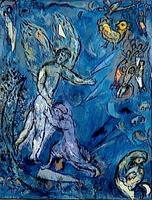
Study to "Jacob Wrestling with the Angel"
Marc Chagall
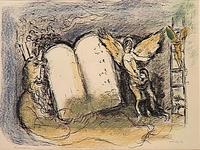
The Vision of Moses
Marc Chagall
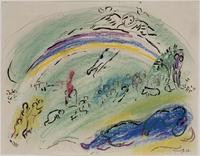
Noah and the Rainbow
Marc Chagall
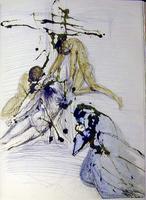
De cruce depositio
Salvador Dali
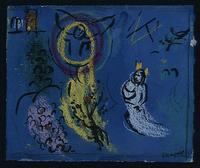
Moses with the Burning Bush
Marc Chagall
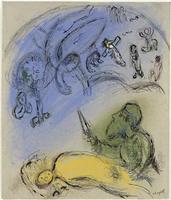
The sacrifice of Isaac
Marc Chagall