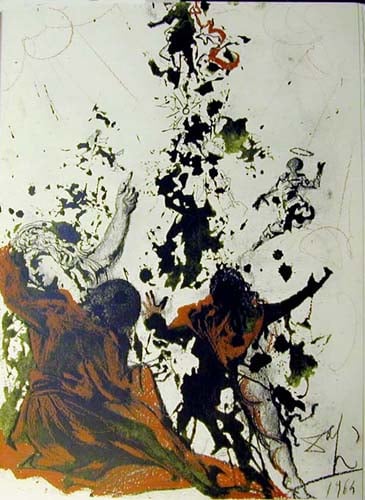
Iesu transfigurato (Mark 9:4f)
Dettagli
Analisi esperta di Iesu transfigurato (Mark 9:4f) di Salvador Dali
Stile: Abstract Expressionism, Symbolism · Genere: religious painting
Expert Analysis of Salvador Dalí’s Iesu transfigurato (Mark 9:4f)
While Salvador Dalí is best known as a master of Surrealism, his Classic Period (1941–1989) marked a profound turn toward religious and historical subjects, often rendered with a blend of technical virtuosity and deeply personal symbolism. This painting, Iesu transfigurato (Mark 9:4f), exemplifies that later direction by fusing two seemingly contradictory styles—Abstract Expressionism and Symbolism—within the framework of a traditional religious genre. The result is a work that is both spiritually charged and formally radical, significant for its ability to reconcile avant-garde energy with centuries-old iconography.
Stylistic Synthesis and Significance
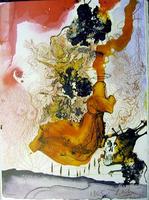
The attribution to Abstract Expressionism is unusual for Dalí, whose work typically remained figurative and meticulously detailed. Here, however, the transfiguration of Christ—a moment of divine radiance described in the Gospel of Mark—is likely conveyed through bold, gestural brushwork, fields of intense color, and a dissolution of representational form. This choice aligns with the Abstract Expressionist emphasis on emotional immediacy and the sublime, allowing the “light” of the Transfiguration to become a physical, almost explosive presence on the canvas. The painting may blur the boundaries between the human figure of Jesus and the surrounding atmosphere, suggesting that the divine event transcends literal depiction.
Simultaneously, the Symbolism inherent in Dalí’s method imbues every element with layered meaning. The title directly references Mark 9:4–5, where Moses and Elijah appear with Jesus. Dalí likely employs his characteristic symbolic vocabulary—perhaps including fragmented or distorted forms, mathematical or optical motifs, or references to nuclear mysticism (a theme he explored in the 1950s). The transfiguration itself becomes a symbol of spiritual metamorphosis, and Dalí’s use of Abstract Expressionist spontaneity paradoxically serves that symbolic purpose: the chaotic energy of the brushstroke stands in for the ineffable, unrepresentable nature of divine glory.
Placement in Dalí’s Classic Period
This work is significant as a product of Dalí’s Classic Period, a time when he actively sought to marry his surrealist techniques with classical religious painting, Catholic theology, and the science of his era. By incorporating Abstract Expressionism—a movement often associated with secular existentialism and American post-war individualism—Dalí broadened the scope of religious art, showing that spiritual transcendence could be evoked through modern, non-objective means. The painting thus challenges the divide between the sacred and the secular, the figurative and the abstract, the symbolic and the expressive.
Conclusion
Iesu transfigurato stands as a compelling testament to Dalí’s restless innovation. It is significant not only for its bold stylistic hybridity but also for its role in reimagining a core New Testament event for a mid-century audience. Through the fusion of Abstract Expressionism’s raw energy and Symbolism’s profound allusiveness, Dalí creates a visual experience that is both immediate and metaphorical—a fitting representation of a moment when the divine breaks into the visible world.
Visivamente simili
20 opere con composizione e palette affini
Group Surrounding a Reclining Nude - Velazquez
Salvador Dali
San Salvador and Antonio Gaudi Fighting for the Crown of the Virgin
Salvador Dali
Cadaver in seoulchro Elisei (2 Kings 13:21)
Salvador Dali
Studies for the Death of Empedokles
Salvator Rosa
Iesus a Satana tentatur (Mark 1:13)
Salvador Dali
Rubus incombustus (Exodus 3:2)
Salvador Dali
Sponsabo te mihi in sempiternum (Song of Songs 2:12)
Salvador Dali
Woman Hitting Another Woman with a Shoe
Francisco Goya
Projet de frontispice pour Macbeth
Luc-Olivier Merson
The Trinity
Salvador Dali
Studies for Four Figures
Palma il Giovane
Study for the figure of Saint Simon
Noè Bordignon
Mariae annunciato (Luke 1:26f)
Salvador Dali
Iesus flagellatus (John 19:1)
Salvador Dali
Moses breaks Tablets of Law
Marc Chagall
Laliberatrice
Theophile Steinlen
Seated Female Holding a Book, Two Heads of Bearded Men, Seated Male Nude, and Four Sketches for Christ Judging (recto); Studies for Cain Slaying Abel (verso)
Palma il Giovane
De cruce depositio
Salvador Dali
Standing Male Figure
Salvator Rosa
Projet d'illustration pour Macbeth - Hécate et les trois sorcières
Luc-Olivier Merson