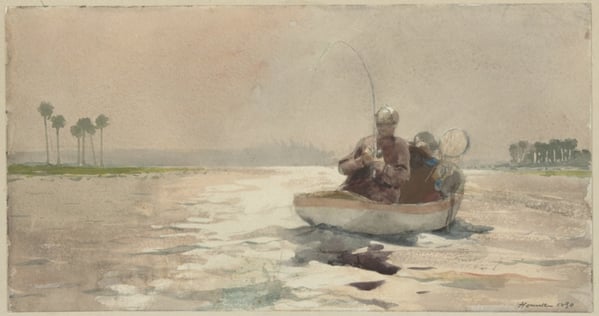
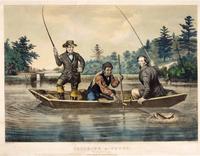
“Bass Fishing, Florida” by Winslow Homer stands as a quintessential example of American Realism and genre painting, capturing a moment of everyday life with meticulous observation and a quiet narrative power. Homer’s work is significant within the Realist tradition for its unflinching yet poetic depiction of ordinary activities—here, a solitary fisherman engaged in bass fishing in a Florida setting. The painting exemplifies the Realist commitment to truthful representation of contemporary life, shunning idealization in favor of direct, unembellished scenes drawn from the artist’s own encounters.
As a genre painting, it elevates a commonplace leisure activity to a subject worthy of fine art, reflecting the 19th-century shift toward celebrating the dignity of common experience. Homer’s masterful handling of light and atmosphere—likely capturing the humid, subtropical quality of Florida—grounds the scene in a specific geographic and temporal reality, while the focused composition on the fisherman and his catch reinforces the realist focus on human labor and interaction with nature. The work’s significance lies in how it synthesizes the regional specificity of Florida’s landscape with the universal themes of patience, skill, and man’s connection to the natural world, making it a compelling document of American life as seen through the clear, unsentimental lens of Realism.