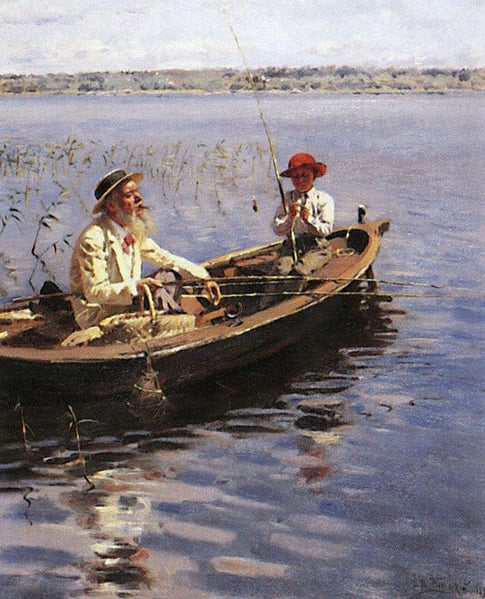
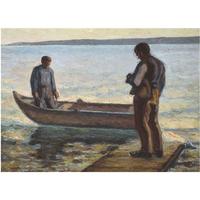
Vladimir Makovsky’s Fisherman. Finland. is a quintessential example of Russian Realism, a movement dedicated to depicting the unvarnished lives of ordinary people. As a genre painting, its significance lies in Makovsky’s ability to elevate a humble, everyday activity – fishing – into a moment of quiet dignity and psychological depth.
The work’s Finnish setting is crucial: it situates the fisherman within a specific northern landscape, likely stark and unromantic, which aligns with the Realist ethos of portraying authentic regional life rather than idealized scenes. Makovsky’s mastery lies in his focus on the individual’s worn expression and weathered hands, revealing the toil and resilience inherent in such a subsistence livelihood. The painting’s significance stems from its refusal to sentimentalize or moralize; instead, it offers a direct, empathetic record of a working man’s existence, capturing the stoic realism that defines the period’s best genre works. This piece demonstrates how Makovsky, like his contemporaries, used the unremarkable to illuminate the universal human condition.