Analisi esperta di In the Fields. Spring di Alexey Venetsianov
Stile: Realism · Genere: genre painting
Expert Analysis of "In the Fields. Spring" by Alexey Venetsianov
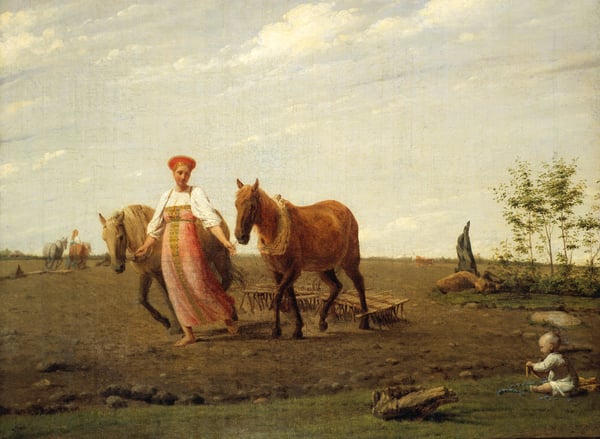
This work is a quintessential example of Alexey Venetsianov’s pioneering contribution to Russian Realism, elevating the humble genre painting of peasant life to a subject of profound artistic and social significance. Completed during the early 19th century, In the Fields. Spring embodies Venetsianov’s break from the prevailing Neoclassical and Romantic conventions that idealized nobility or mythological scenes. Instead, he turned his unflinching, yet compassionate, eye to the daily rhythms of rural Russia, capturing the dignity of labor and the quiet poetry of the land.
Stylistic and Formal Significance
Venetsianov’s Realism is marked by a meticulous observation of natural light, atmosphere, and the textures of the countryside. In this painting, the soft, diffused light of spring—likely early morning or late afternoon—bathes the field in a warm, golden glow, subtly modulated to emphasize the vastness of the landscape and the fleeting season’s renewal. The composition grounds the viewer in the immediacy of the scene: the earthy browns of tilled soil, the pale greens of emerging shoots, and the simple, sturdy clothing of the peasant figures. There is no dramatic gesture or idealization; the figures are absorbed in their task, their postures relaxed yet purposeful, suggesting a symbiotic relationship with the earth. This attention to quotidian detail—the weight of a tool, the bend of a back—was revolutionary, as it granted peasant laborers a gravity previously reserved for historical or mythological subjects.
Significance Within Russian Art and Society
Venetsianov’s work was a quiet but powerful social statement. At a time when Russian serfdom was still deeply entrenched, he portrayed peasants not as anonymous laborers or sentimentalized “folk,” but as individuals with inherent dignity. In the Fields. Spring celebrates the essential, life-giving role of agriculture and seasonal renewal, linking human effort to the natural cycle. The artist’s choice of the spring season—a time of hope and rebirth—further reinforces a sense of resilience and continuity. By focusing on genre painting, Venetsianov helped establish a national artistic identity rooted in authentic Russian life, influencing later Realists like Ilya Repin and the Peredvizhniki (the Wanderers). His Academy of Art in Safonkovo, where he taught peasant children to paint, underscores his commitment to this ethos.
In summary, In the Fields. Spring is significant as a foundational work of Russian Realism: it transforms a simple agrarian moment into a universal meditation on labor, nature, and human perseverance, forever altering the trajectory of Russian art by proving that the everyday could be as powerful and beautiful as the heroic.
Museum / Gallery
Visivamente simili
20 opere con composizione e palette affini
Hungarian Farmers with Wagon
August von Pettenkofen
The Hay Harvest
Heinrich Bürkel
Harvest
John Frederick Herring Sr.
Cornfield
David Cox
A Landscape with a Fallen Hay Wain
Heinrich Bürkel
Peasants Resting in the Field
Albrecht Adam
Crossing of the River Oyat
Vasily Polenov
Haymakers
George Stubbs
Ploughing
Rosa Bonheur
On The Tow Path, Walton On Thames
John Absolon
Hay Harvest in Threatening Weather
Rudolf Koller
The Kiss
August von Pettenkofen
Threshing
Jesús Meneses del Barco
Bivouac Russian soldiers
August von Pettenkofen
In the mangel field
David Bates
Ploughing
George Clausen
The collector of gravel and sand from the rivers
Amedeo Bocchi
Portrait of Leo Tolstoy as a Ploughman on a Field
Ilya Repin
Hungarian farmer's wagon by the water
August von Pettenkofen
The Last Furrow
Henry Herbert La Thangue