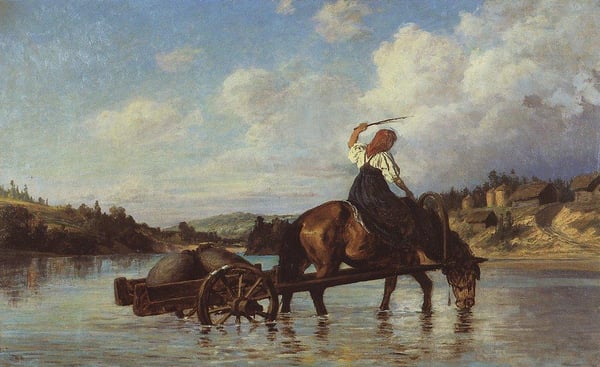
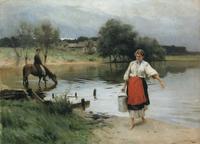
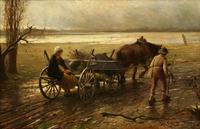
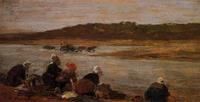
Vasily Polenov’s Crossing of the River Oyat stands as a compelling intersection of Russian Realism and Romanticism, showcasing how a seemingly mundane genre scene can achieve profound emotional and artistic significance. The work exemplifies the Realist commitment to truthful, unidealized representation—capturing the everyday labor and travel of ordinary people with meticulous attention to detail, from the texture of the river’s surface to the weary posture of the figures. Yet at the same time, the painting is infused with a Romantic sensibility: the vast, luminous sky, the dramatic play of light on water, and the sense of a journey imbued with both struggle and quiet heroism transform a simple crossing into a poignant metaphor for human perseverance within the grandeur of nature. This dual allegiance to Realism’s social authenticity and Romanticism’s emotional resonance places the work as a significant example of how late-19th-century Russian painters elevated genre painting beyond documentary reporting, using it to explore universal themes of endurance, place, and the sublime in everyday existence.