Expert analysis of Alexey Venetsianov’s Morning of the Landlady
Style: Realism · Genre: genre painting
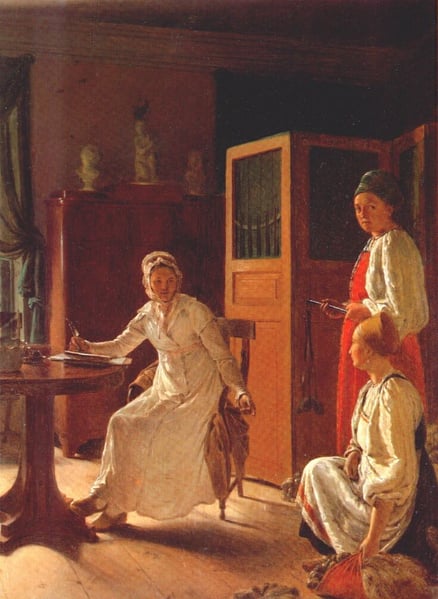
Expert Analysis: "Morning of the Landlady" by Alexey Venetsianov (c. 1823)
Alexey Venetsianov’s Morning of the Landlady stands as a seminal work within the early development of Russian Realism, marking a decisive shift from the idealized, neoclassical conventions of the 18th century toward a truthful, unadorned depiction of everyday life. Painted during a period when Russian art was dominated by academic history painting and portraiture of the aristocracy, Venetsianov turned his gaze to the domestic sphere of the provincial gentry and, more importantly, to the lives of the serfs who sustained it.
The scene unfolds in a modest, sunlit interior: a landowner, dressed in a simple morning gown, presides over the start of her day while a servant girl attends to her duties. The composition is quiet and intimate, devoid of dramatic gesture or moralizing narrative. Instead, Venetsianov focuses on the natural rhythms of daily routine—the pouring of tea, the soft play of light across fabric and wood, the subtle exchange between mistress and maid. This attention to the mundane as worthy of artistic contemplation was radical for its time.
What makes Morning of the Landlady especially significant within the Realist style is its subtle but profound social observation. Venetsianov does not romanticize the landowner’s authority nor sentimentalize the servant’s labor; he presents both figures with an even, empathetic clarity. The servant is not a generic type or a picturesque accessory but a distinct individual, her stance and expression suggesting a quiet competence. In doing so, Venetsianov challenges the hierarchical conventions of genre painting, where servants often appear as background props. Here, the relationship between the two women is rendered with a naturalism that invites the viewer to consider the unseen structures of daily existence in rural Russia.
Stylistically, the painting is a masterclass in the Realist credo of “truth over ideal.” The soft, diffused light that enters from the window is not merely decorative—it defines space, models forms, and conveys the time of day with precision. The textures of linen, wood, and ceramic are rendered with a tactile fidelity that grounds the scene in tangible reality. Venetsianov’s palette is restrained, favoring warm earth tones and muted whites, avoiding the high-key color of Romantic or Rococo works.
As a cornerstone of Russian Realism, Morning of the Landlady paved the way for the later, more politically charged works of the Peredvizhniki (The Wanderers). Yet Venetsianov’s approach is gentler: his realism is one of quiet dignity, finding profound significance in the ordinary. The painting remains a landmark not only for its technical skill but for its early acknowledgment that the lives of the common people—and the quiet moments that shape them—deserve a place in the canon of high art.
Visually similar
20 works with related composition and palette

L'heure de thé
Edward Portielje
The Winning Hand
Edward Portielje
Two mothers. Native mother and stepmother.
Vladimir Makovsky
The Seamstress
Frank W. Benson
Exciting reading
Carl Zewy
New friends
Bertha Wegmann
Unexpected Visitors
Ilya Repin
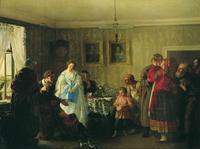
Congratulation of betrothed in landlord's house
Grigoriy Myasoyedov
A Child's Menagerie
Eastman Johnson
Thoughts
Wenzel Tornøe
Three Girls Reading
Edmund Charles Tarbell
The violinist in love
Carl Zewy
Jeune femme assise
Joseph Bail
Household Conversation
Konstantin Makovsky
The wounded man visited by his relatives
Gerolamo Induno
Eine amüsante Geschichte
Edward Portielje

Conversation
Mihaly Munkacsy
H0014 L04615346
Antonio Zoppi
Month of Mary
Joan Brull
A scene of two ladies in an interior
Harry Brooker